Landlord Rasem Ghreir rented a basement laundry room located at 5393 Waverly Terrace, Halifax, NS B3H 1J1 and described it on the lease as “One bedroom in a 4‑bedroom house.”
Monthly rent charged: CA$950 + electricity & water.
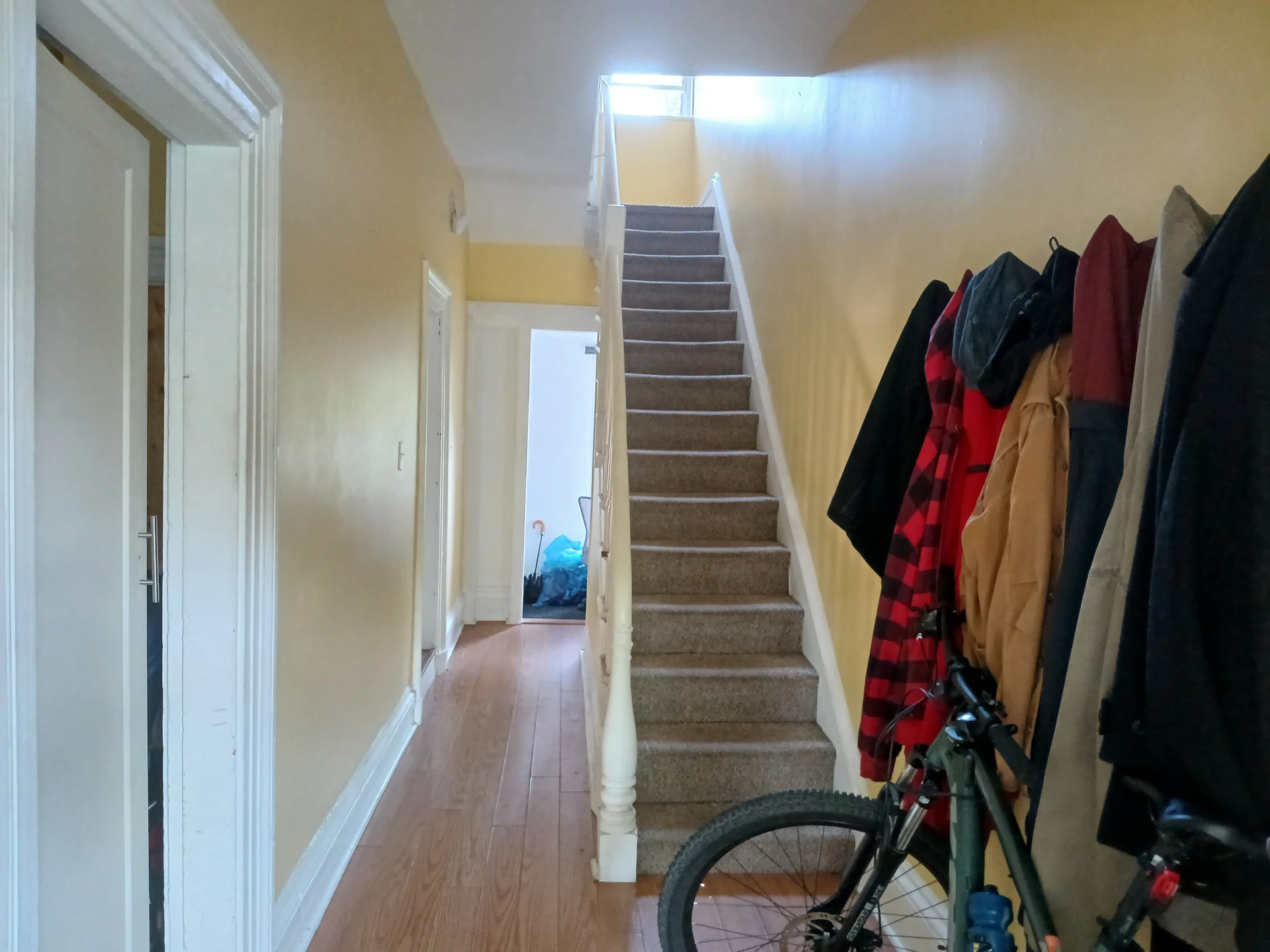
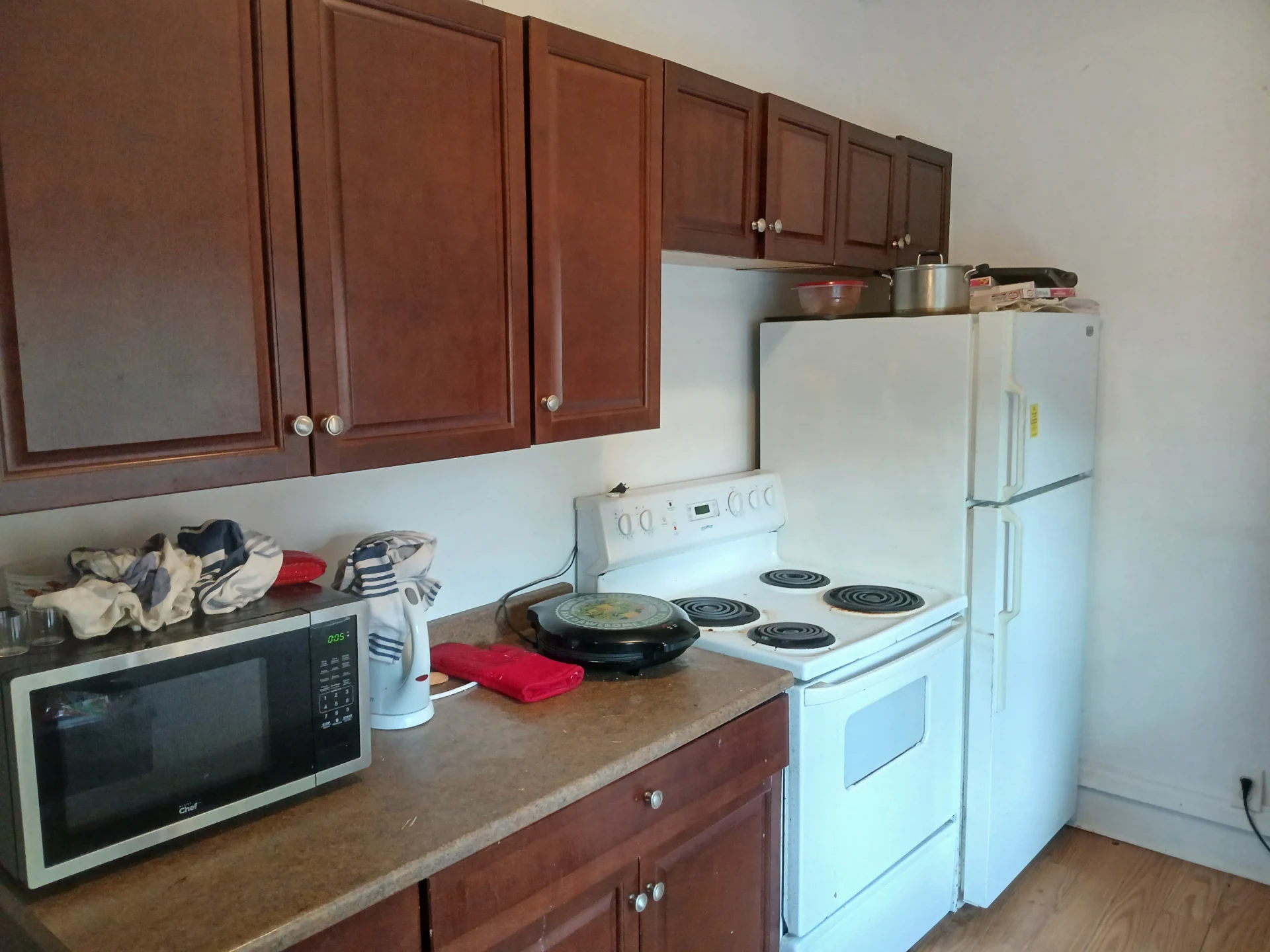
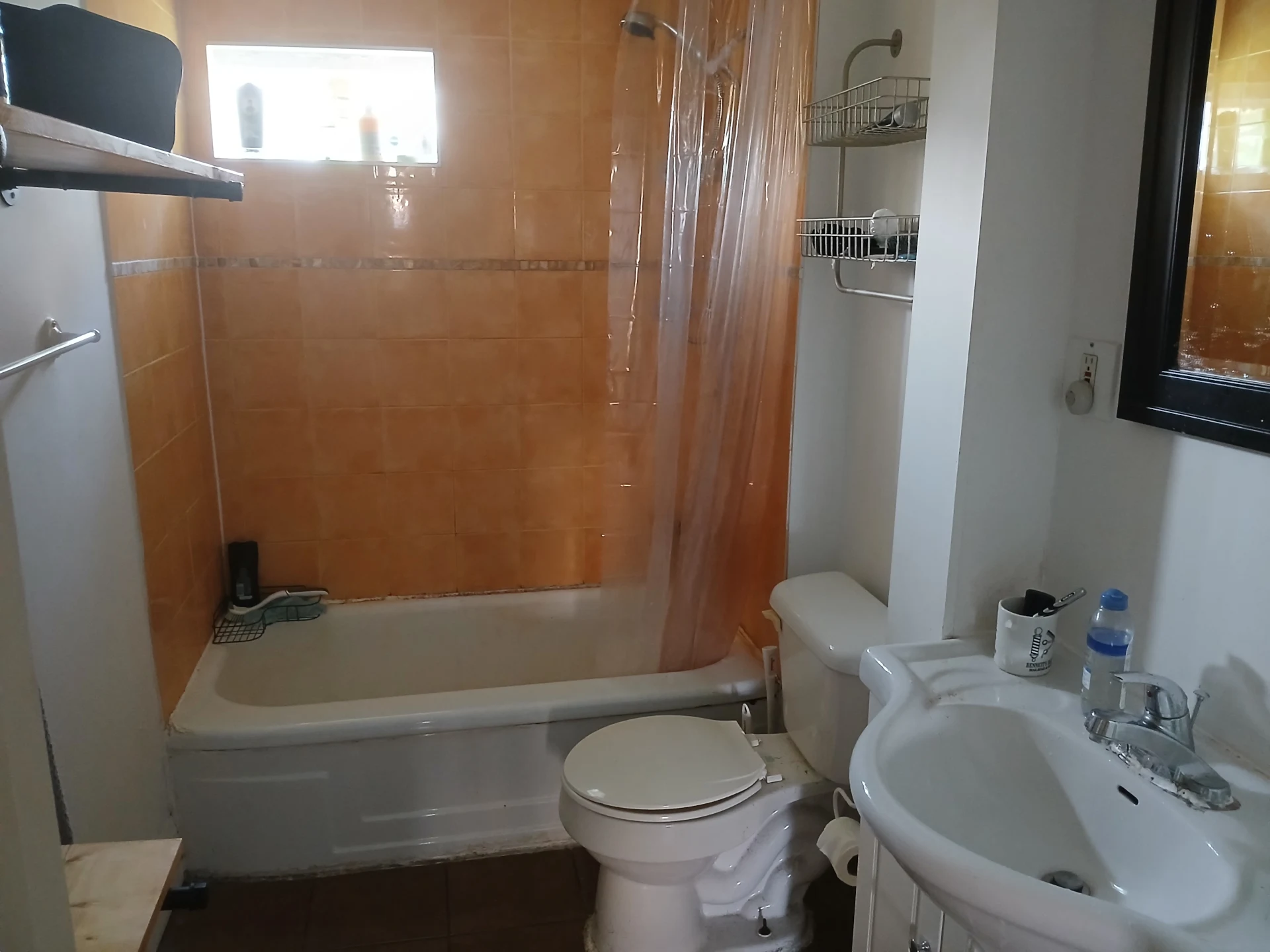
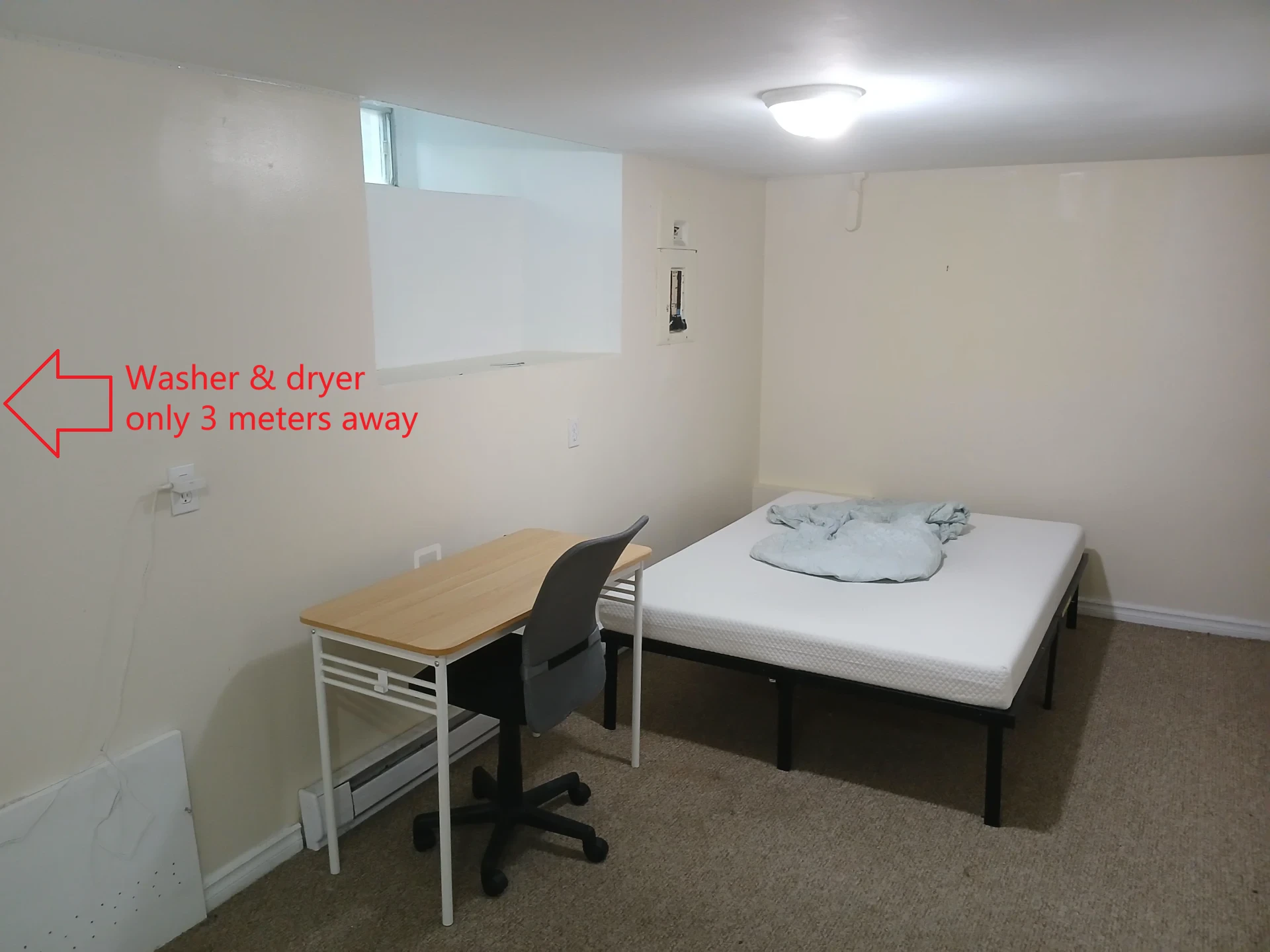
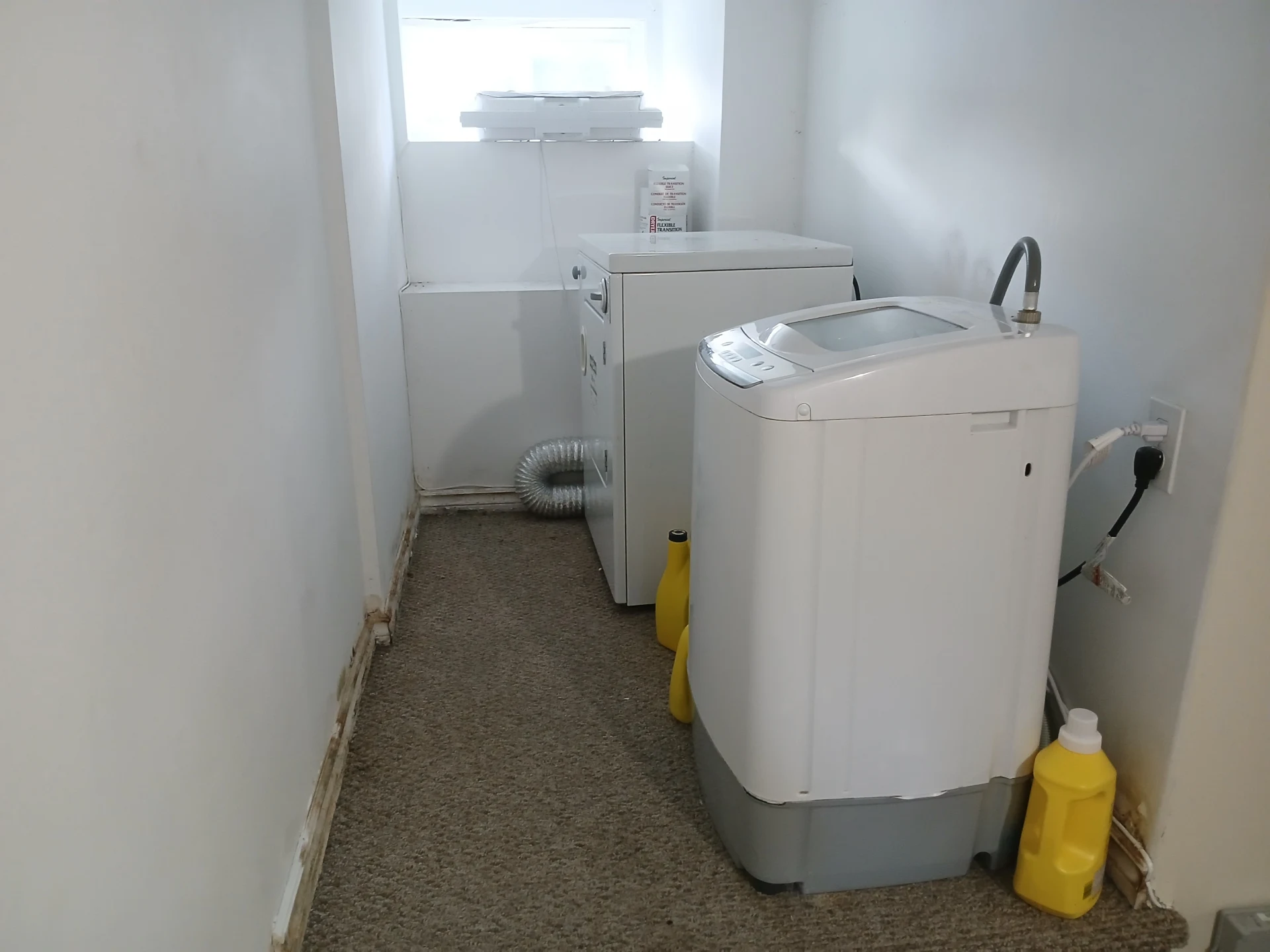
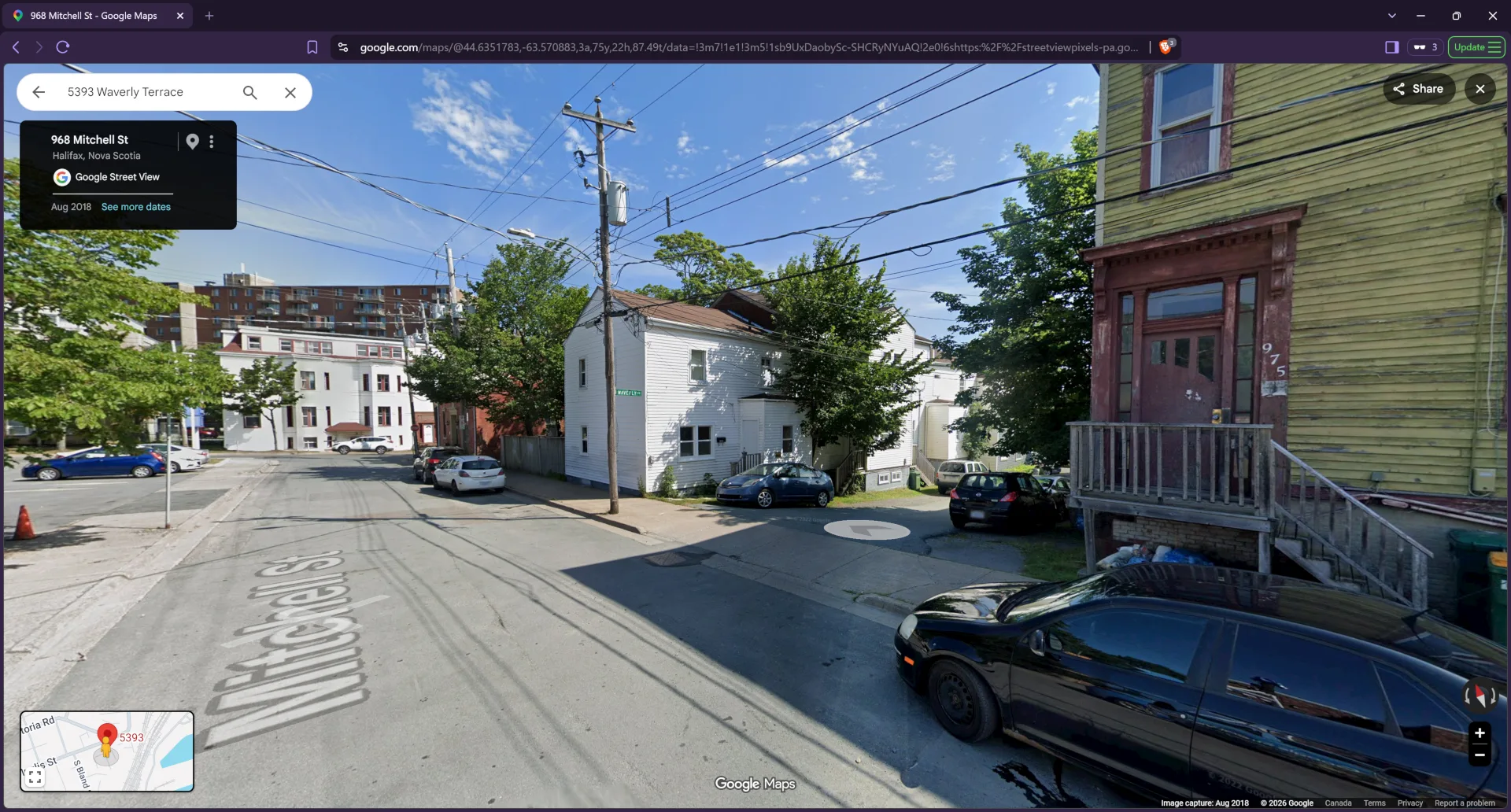
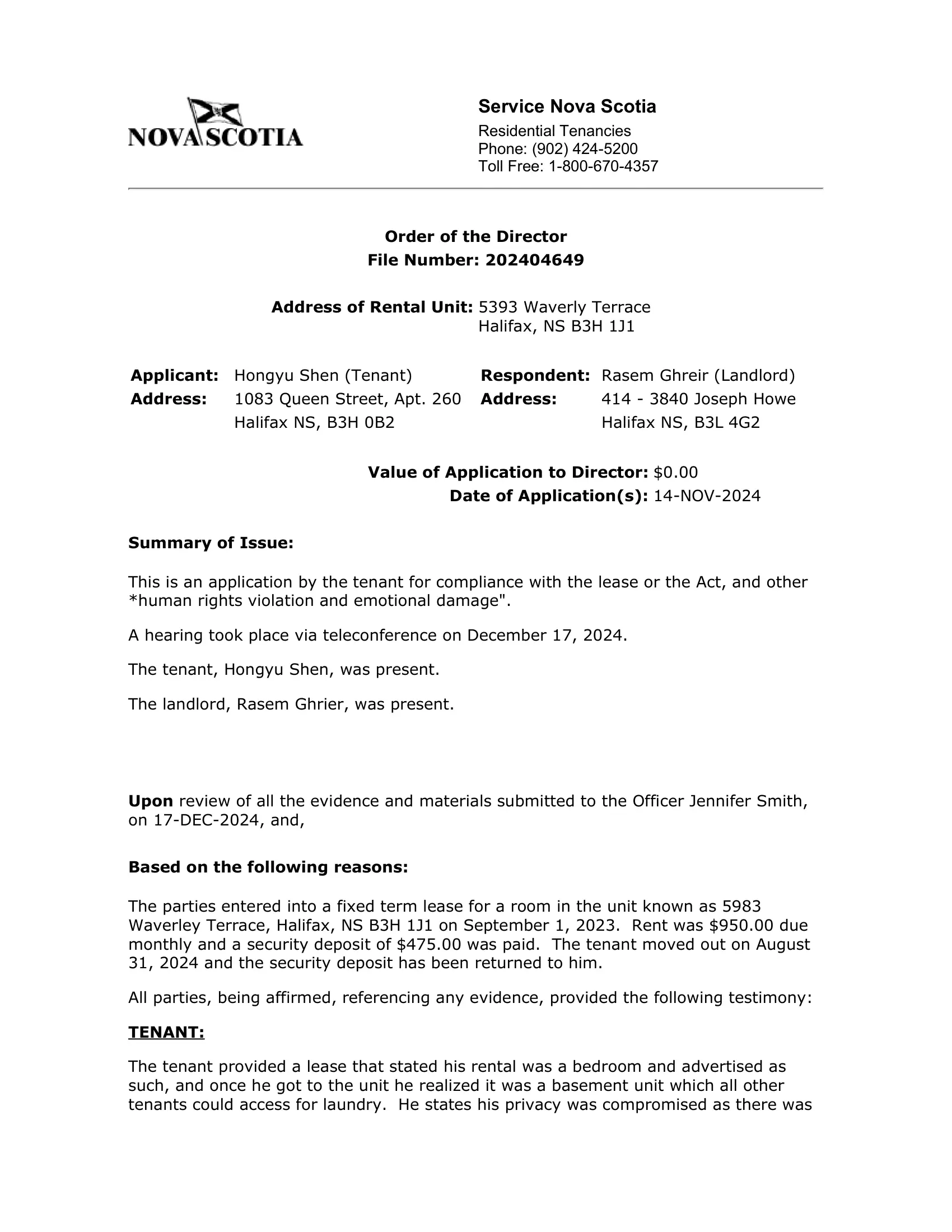
📍 Address of rental unit: 5393 Waverly Terrace, Halifax, NS B3H 1J1, Canada
👤 Applicant (victim tenant): Hongyu Shen
🏠 Address: 1083 Queen Street, Apt. 260, Halifax NS, B3H 0B2
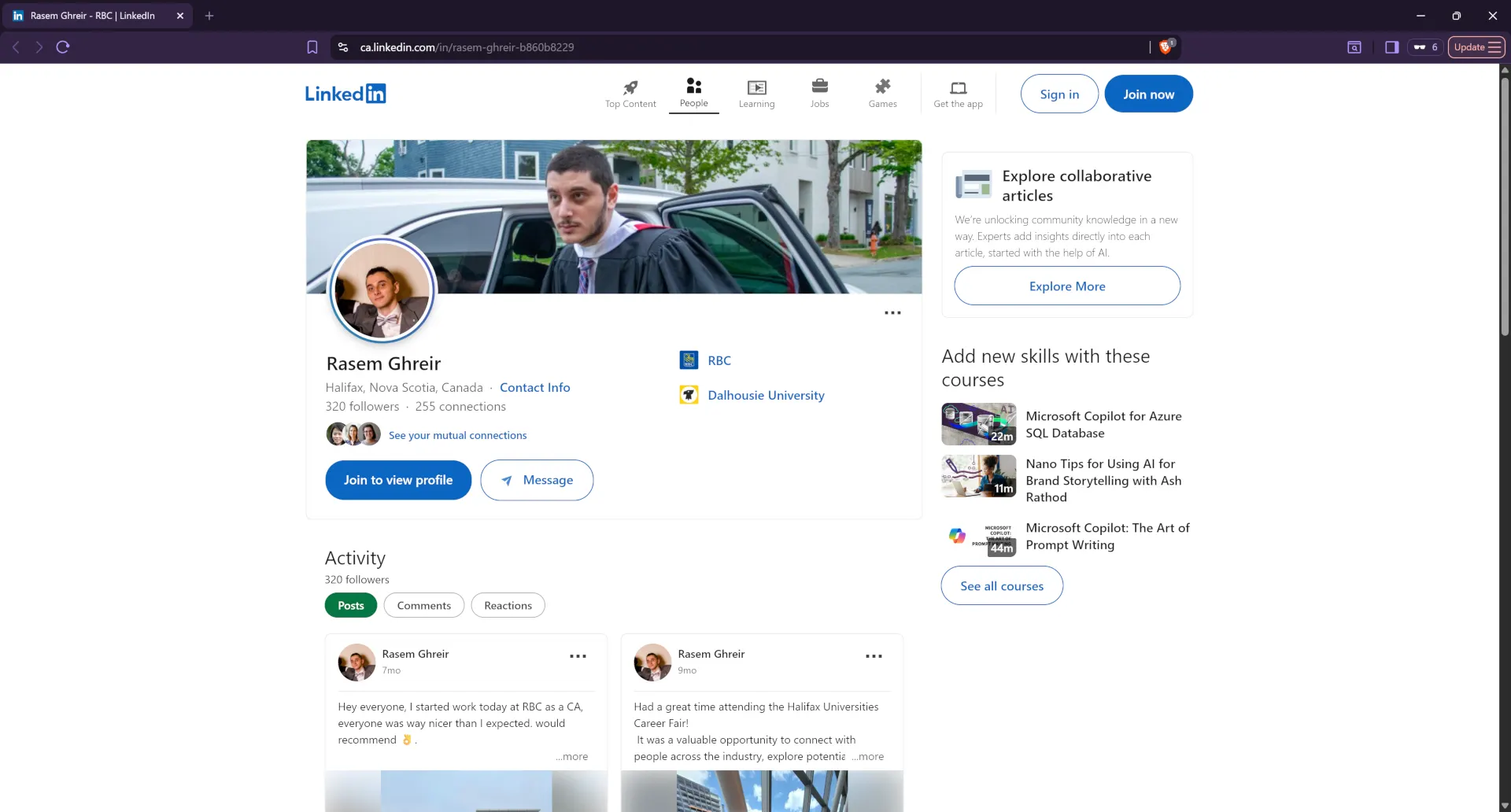
🧑💼 Respondent (landlord): Rasem Ghreir
🏢 Address: 414 - 3840 Joseph Howe, Halifax NS, B3L 4G2
🪪 LinkedIn:
https://ca.linkedin.com/in/rasem-ghreir-b860b8229
The victim tenant contacted the Residential Tenancies office for assistance. The hearing took place on December 17, 2024.

Explanation
Legal issues about the landlord:
Timeline
- Broke the law - Residential Tenancies Act
- Breached the contract(lease): Rented out a laundry room as a bedroom
- Harmed the tenant’s rights: right to live safely, right to quiet enjoyment, right of privacy
Facts
- August, 2023: I moved to Halifax, Nova Scotia and looked for a place to live. I saw the rental advertisement(no picture shown) posted by landlord Rasem Ghreir on Kijiji. I contacted him but had no chance to see the room since he was out of province. I signed the one-year lease due to the urge to settle down.
- September, 2023: I moved in on September 1. Washing machine and dryer were installed in the basement, and I lived there as well.
- May, 2024: Landlord Rasem Ghreir asked me if I wanted to renew the lease for another year, I agreed because of the severe housing crisis.
- August, 2024: I changed my mind and wanted to cancel the lease, based on the fact that I bought a car in March and became more familiar with driving. Landlord Rasem Ghreir told me that I had to find someone to sublet, so I posted a rental advertisement to look for potential tenants. After a few weeks I still had no success. Later I talked to landlord Rasem Ghreir and eventually both agreed on prematurely terminating the new lease by paying 1.5 months of rent.
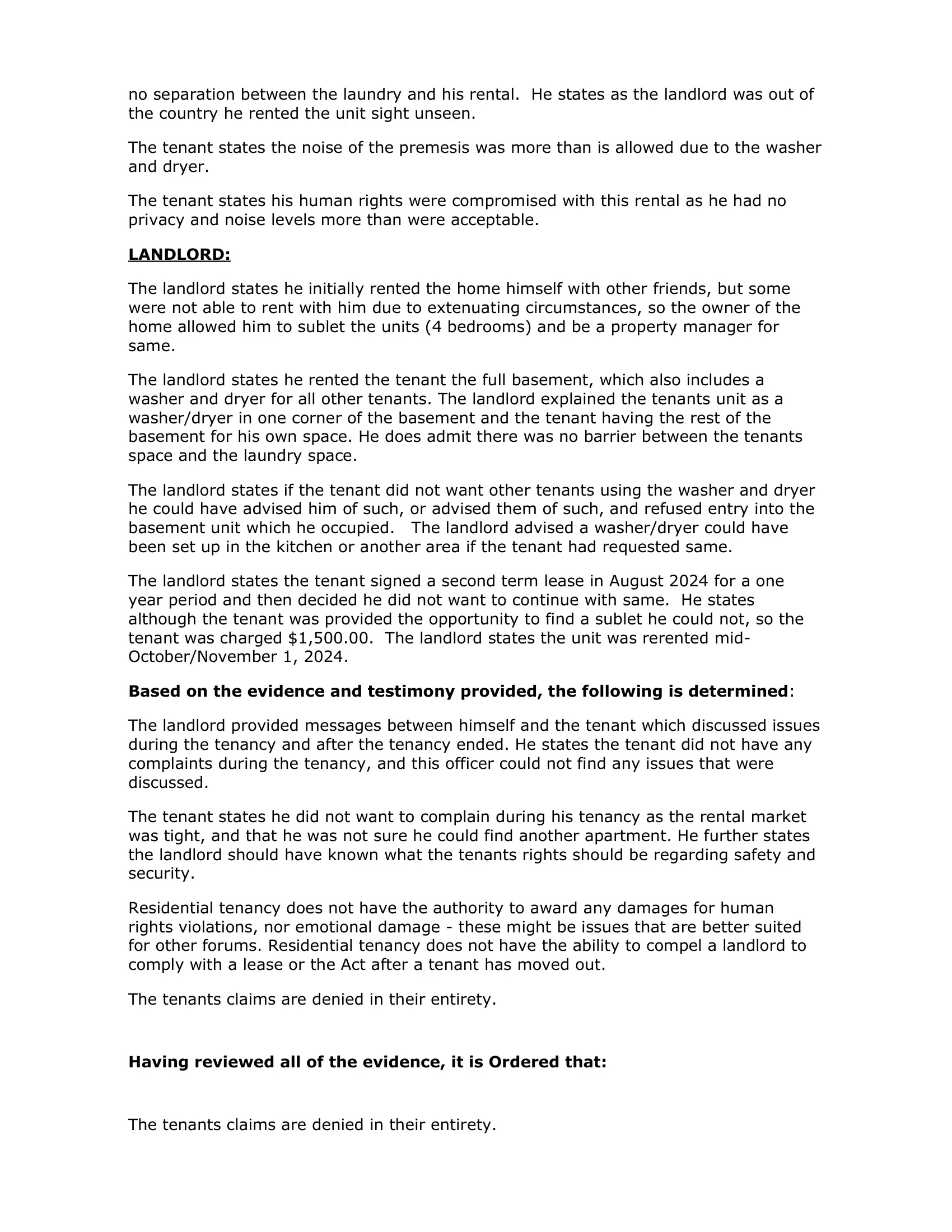
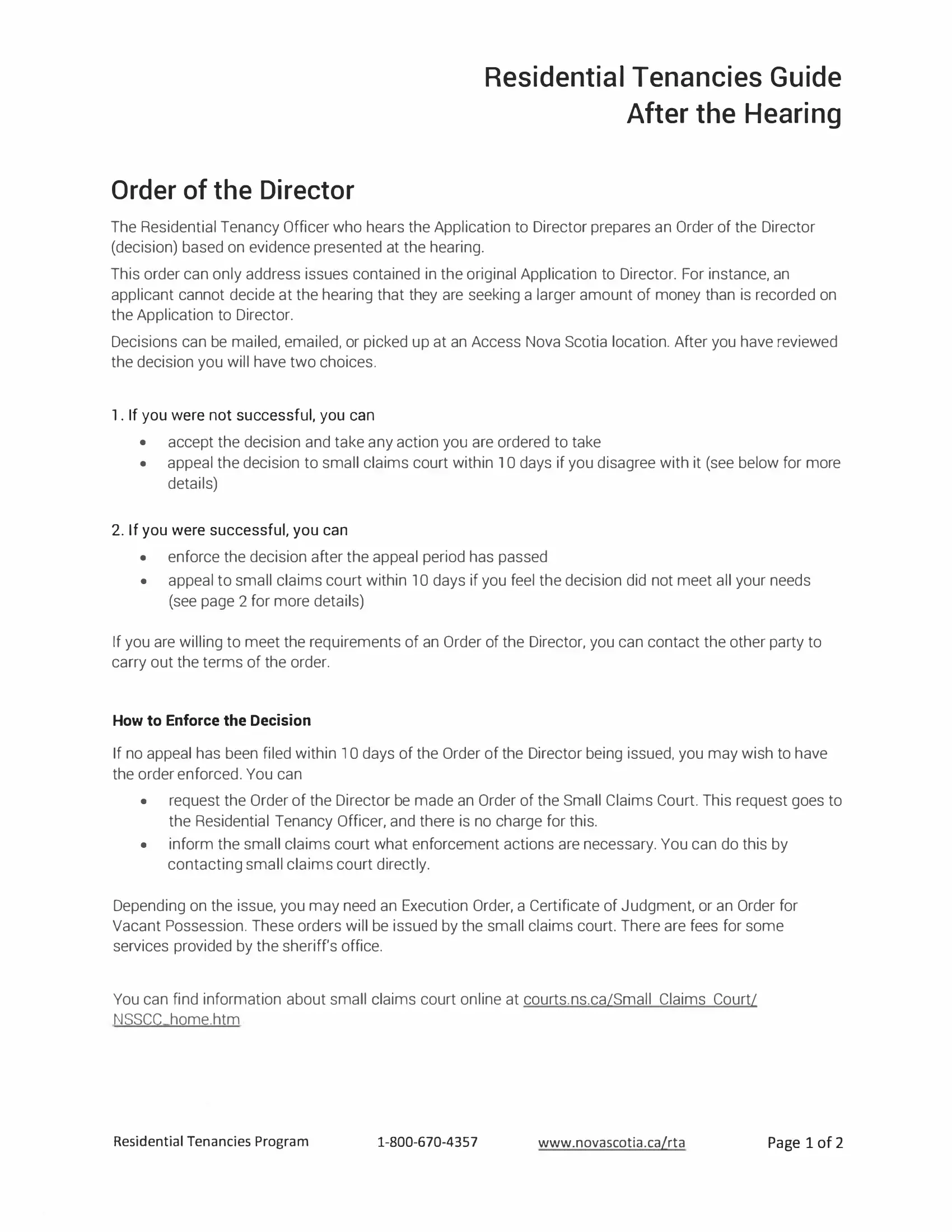
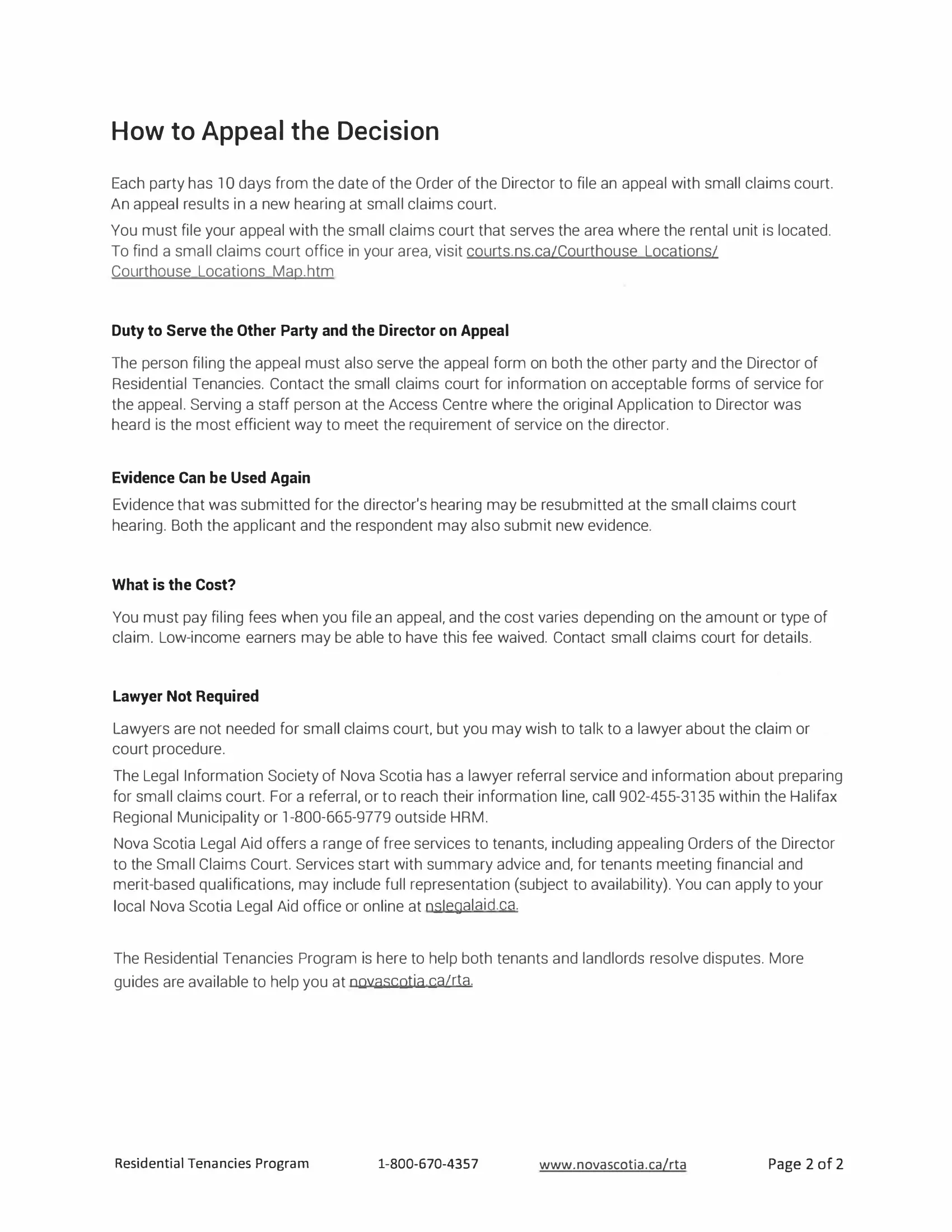
- December, 2024: Residential Tenancy hearing was held but my case was out of their scope. They don’t have the authority to award any damage for rights violation or emotional damage.
Additional information
- No viewing opportunity prior to signing lease
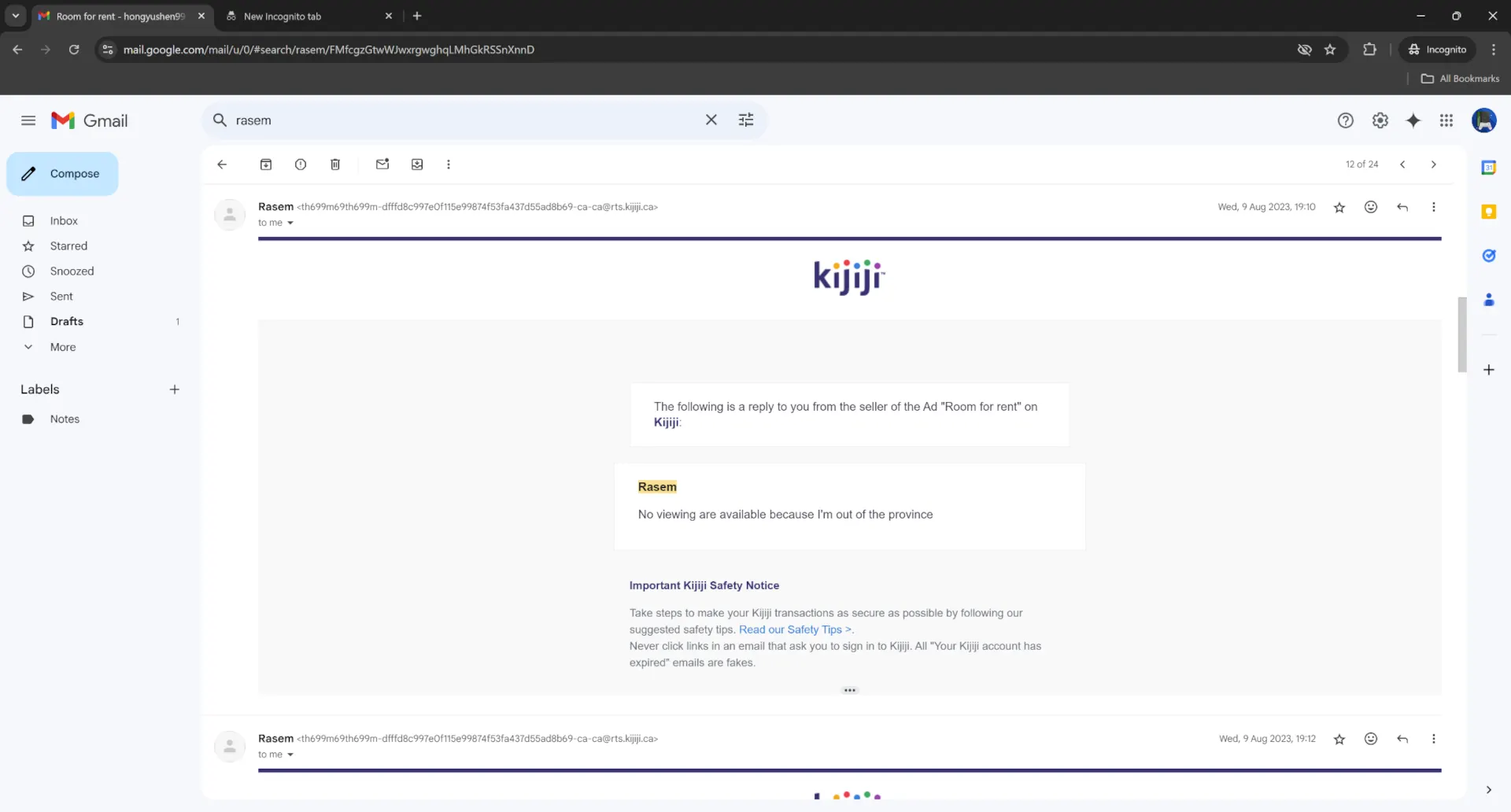
- See “Picture Evidence” document, page 1
- Landlord Rasem Ghreir said "No viewing are available because I'm out of the province". When I contacted him on Aug 9, 2023 about the renting ad posted by him on Kijiji, I was unable to see the room before signing the lease and moving in. So there was no chance to know what my room looked like.
- Landlord rented out the room without doing inspection
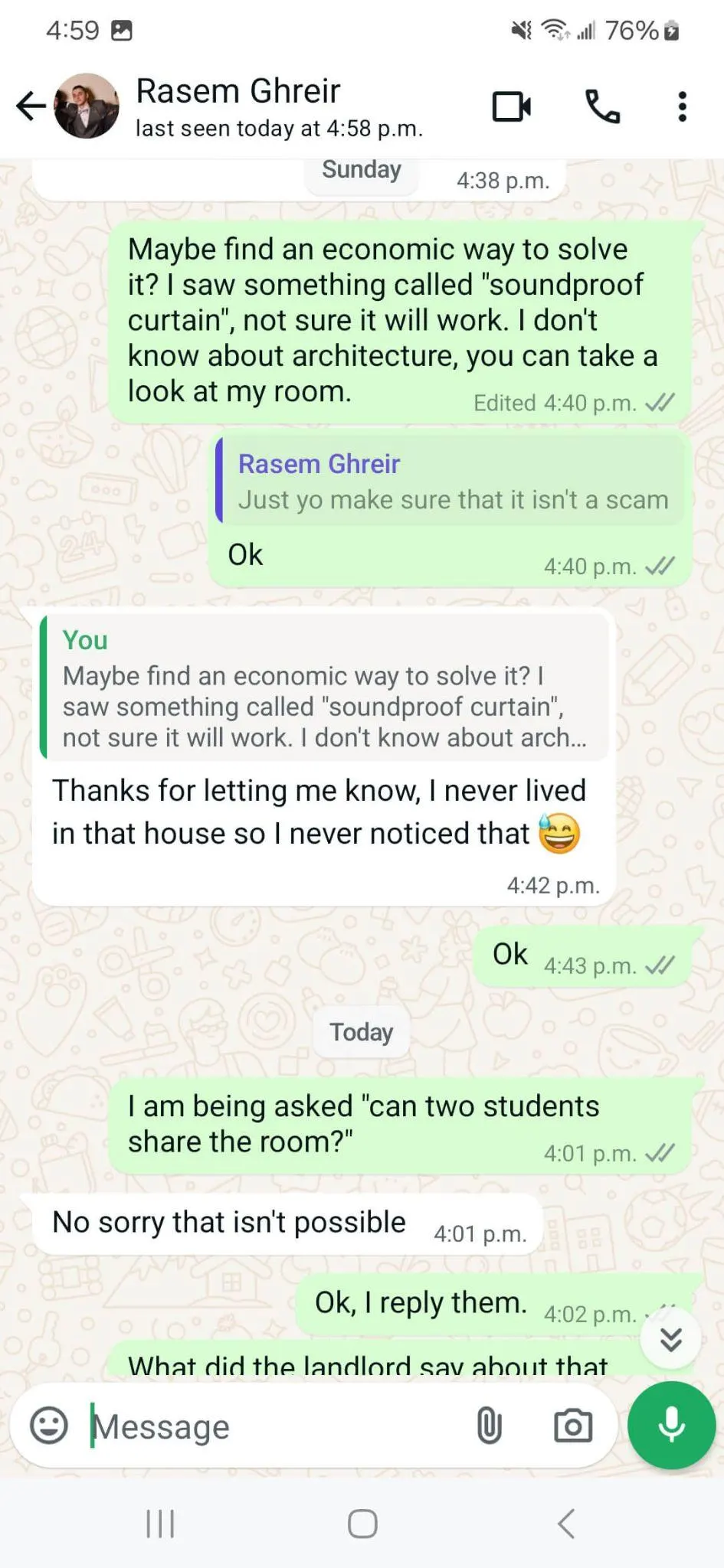
- See “Picture Evidence” document, page 7
- Landlord Rasem Ghreir said "I never lived in that house so I never noticed that" after I mentioned the noise issue to him. He didn’t notice the privacy issue and security issue as well. It means the landlord didn’t check the living conditions of the room and just rented to tenants directly.
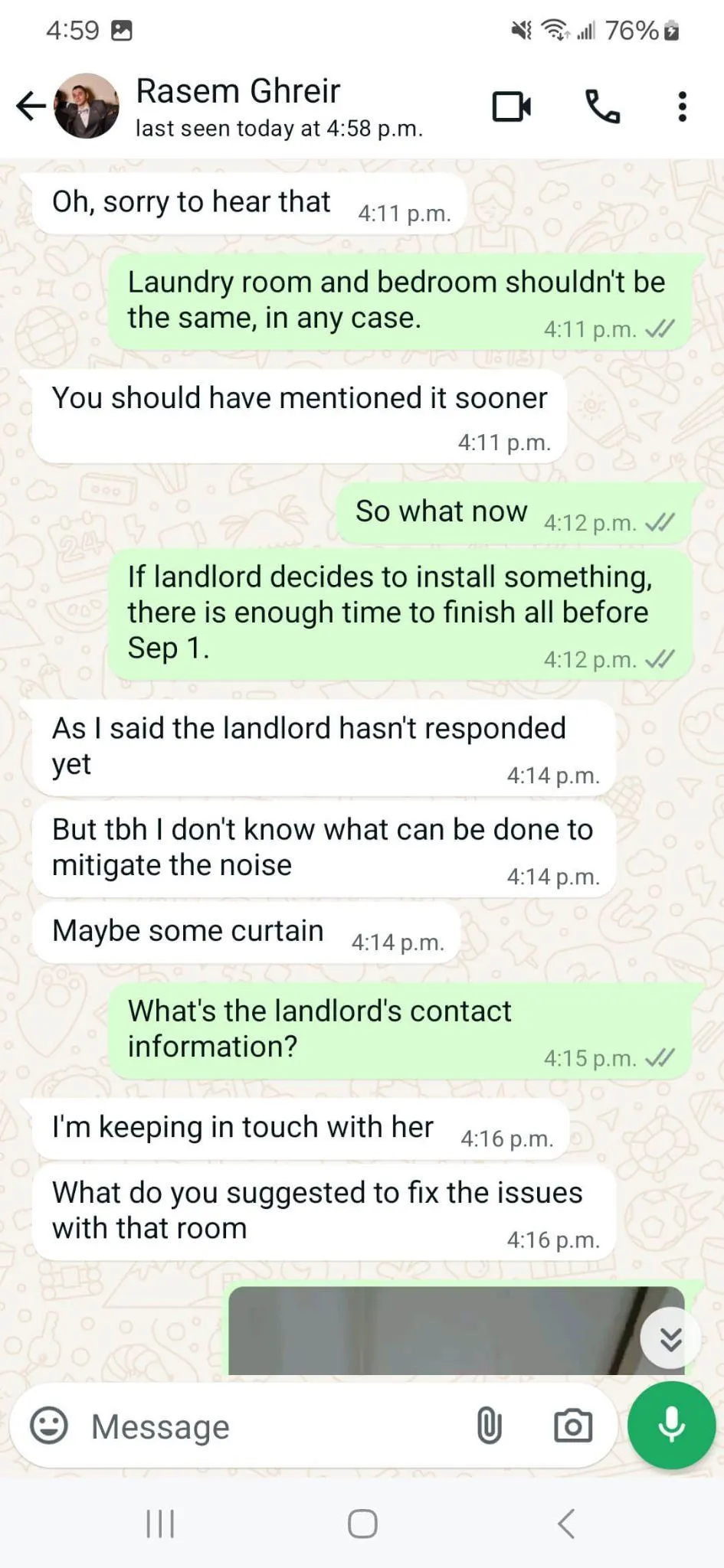
- See “Picture Evidence” document, page 9
- Landlord Rasem Ghreir said “I don't know what can be done to mitigate the noise”, which means he was unable to fix the noise issue.
- Landlord Rasem Ghreir failed to provide a private, safe and quiet place for me to live since the day(Sep 1, 2023) I moved in.
- Reference: Residential Tenancies Act(https://nslegislature.ca/sites/default/files/legc/statutes/residential%20tenancies.pdf) in Nova Scotia, Statutory Conditions 9 (1): Condition of Premises - The landlord shall keep the premises in a good state of repair and fit for habitation during the tenancy and shall comply with any statutory enactment or law respecting standards of health, safety or housing.
- Noise issue acknowledged by landlord
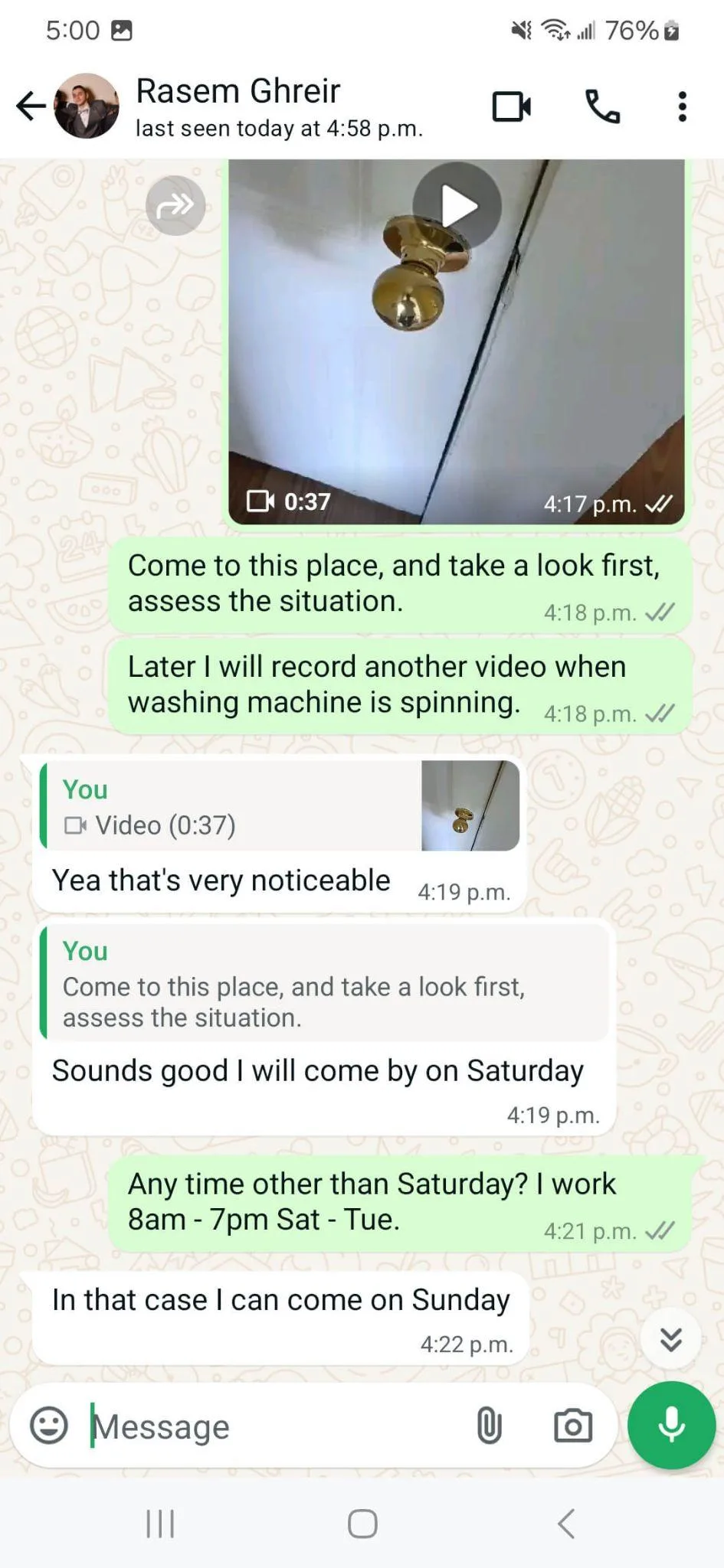
- See “Picture Evidence” document, page 11
- Landlord Rasem Ghreir said "Yea that's very noticeable" after I sent the recorded video of noise. So he admitted that the room has noise issue.
- The tenant’s right to quiet enjoyment was not protected. Reference: Tenant’s Guide To Renting(https://www.lawdepot.ca/tenant/).
- Landlord stated the room as a “bedroom”
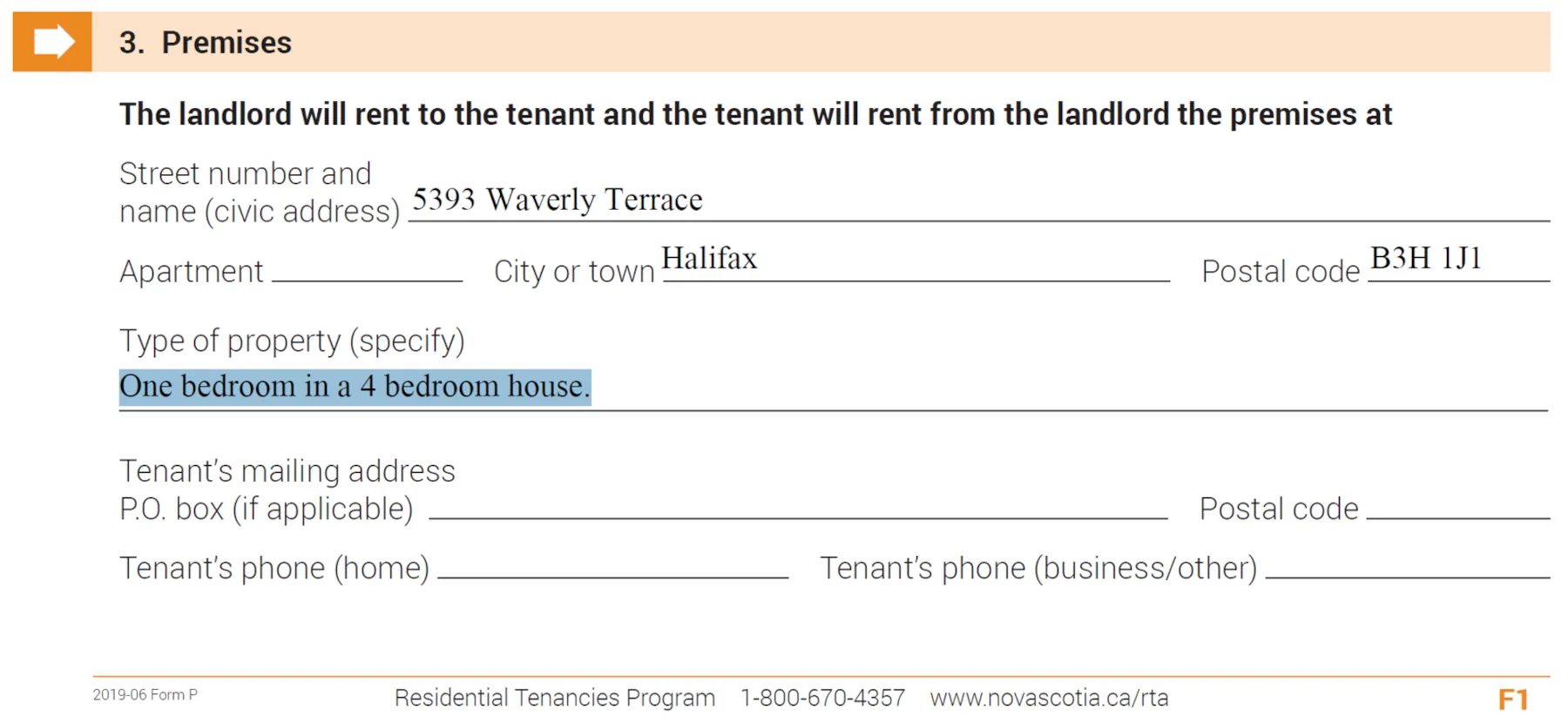
- See “Lease 2023”: It shows "One bedroom in a 4 bedroom house." under the lease Section 3. Premises.
- This room is a basement and has a washing machine and a dryer, which are shared by 3 other roommates.
- This room has no lock on the door.
- Other roommates entered my room frequently because they needed to do laundry.
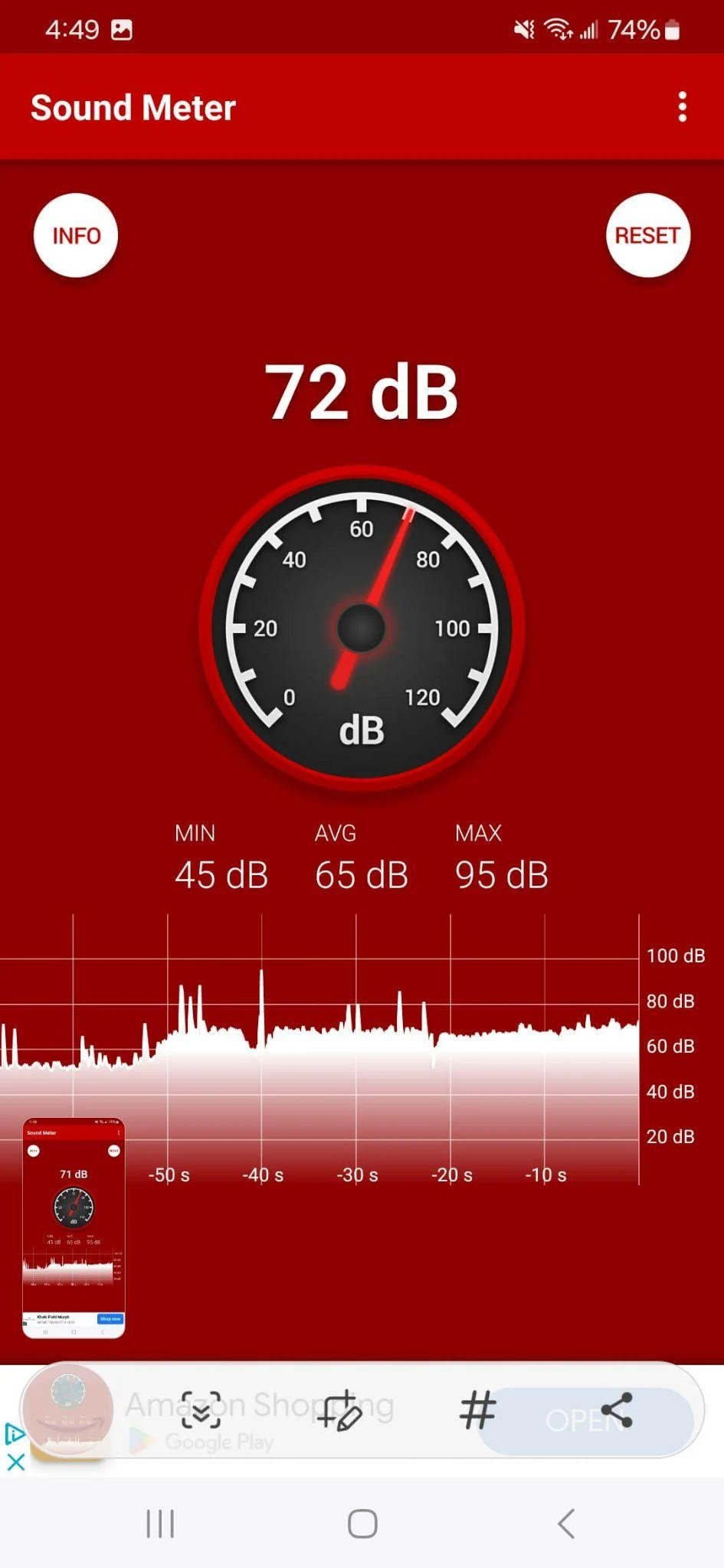
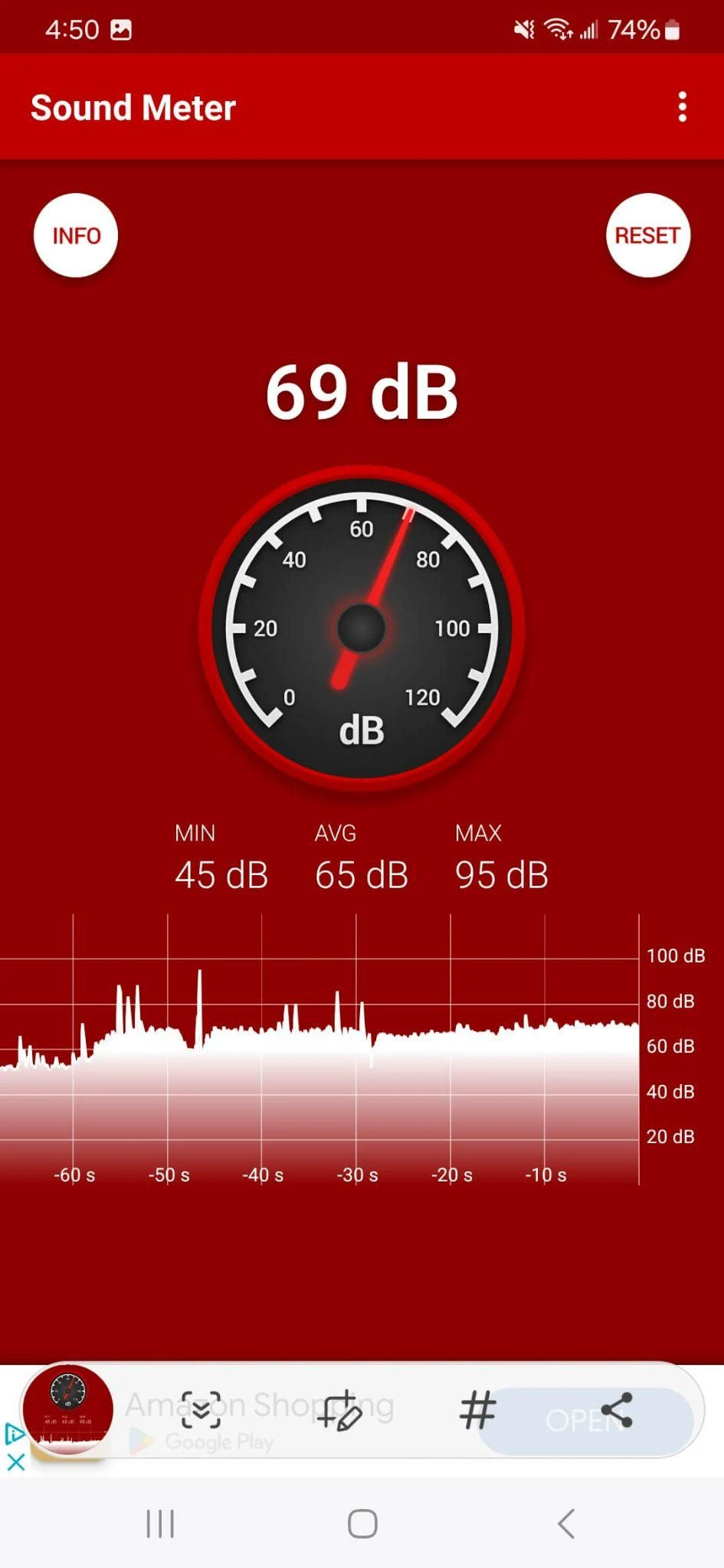
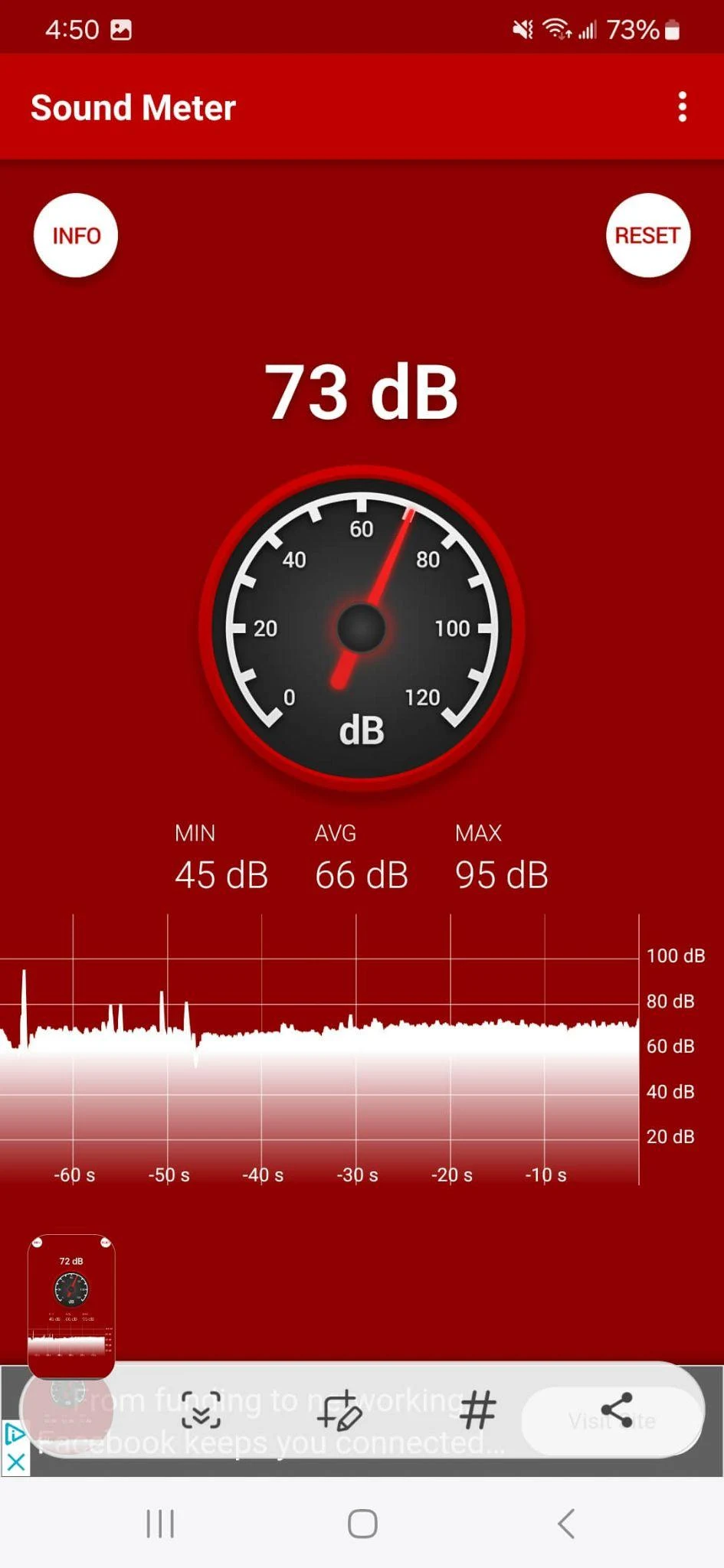
- Noise is between 69 dB to 77 dB when washing machine is running
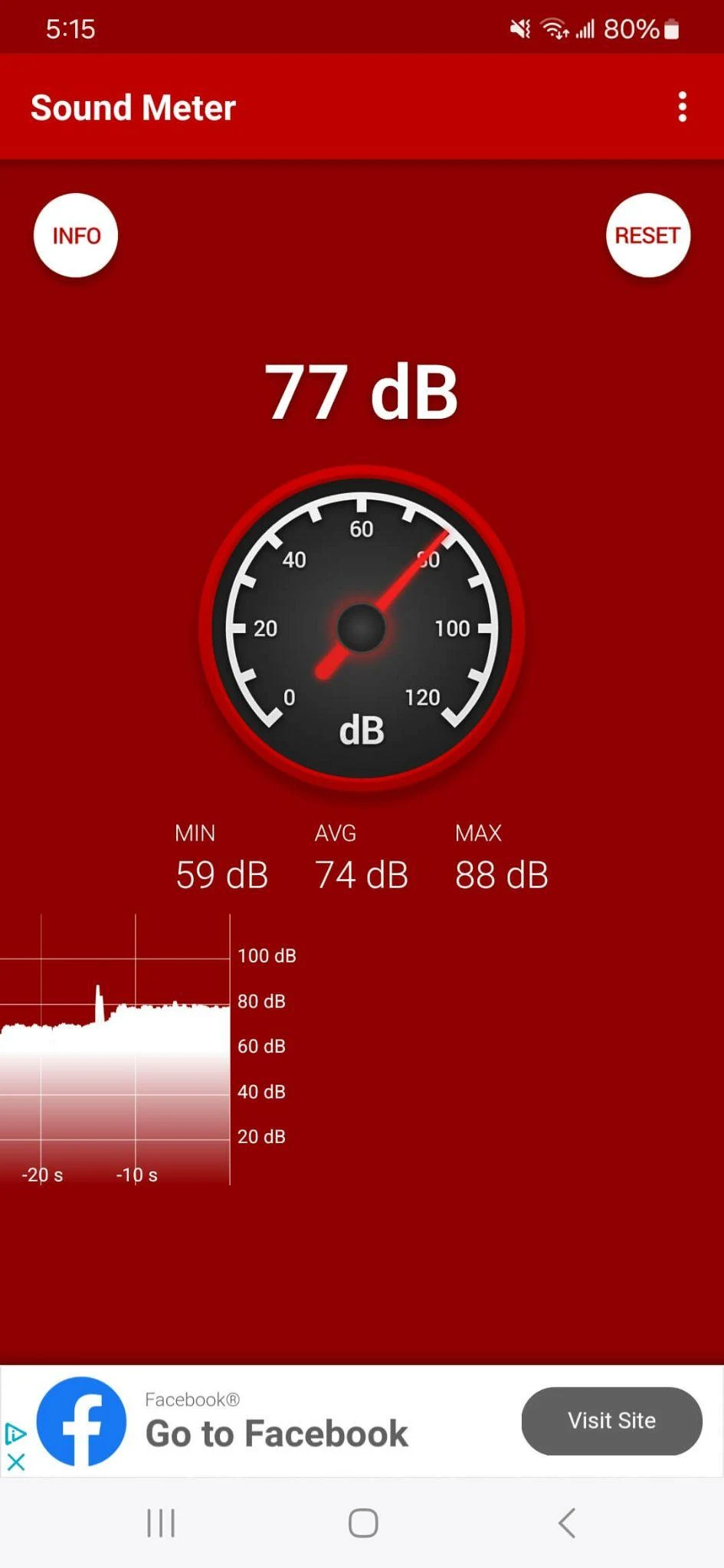
- See “Picture Evidence” document, page 14 ~ page 17
- Noise was tested by Android application “Sound Meter”.
- According to Halifax Regional Municipality “By-law N-200, Respecting Noise”(https://www.halifax.ca/sites/default/files/documents/city-hall/legislation-by-laws/By-LawN-200.pdf): “General Prohibition 3. (1) No person shall engage in any activity that unreasonably disturbs or tends to disturb the peace and tranquillity of a neighbourhood.” Every time the washing machine was running, it disturbed my peace and tranquillity, because washing machine and dryer are about 3 meters to my desk and my bed. No wall/blocking/separation between washing machine and my bed.
- According to Halifax Regional Municipality “By-law N-200, Respecting Noise”(https://www.halifax.ca/sites/default/files/documents/city-hall/legislation-by-laws/By-LawN-200.pdf): “Offence and Penalty 1. for the first offence to a penalty of not less than Three Hundred Dollars ($300.00) and of not more than ten thousand dollars ($10,000.00) or imprisonment for a period of not more than one year or both, including the imposition of the minimum fine;”
- According to “Guidance for Evaluating Human Health Effects in Impact Assessment: Noise”(https://publications.gc.ca/collections/collection_2024/sc-hc/H129-54-3-2023-eng.pdf): “There is no known long-term risk of permanent hearing loss associated with sound levels below 70 A-weighted decibels (dBA), (ISO 1999:2013) and low risk below 85 dBA. However, as sound levels increase, the duration of daily exposure becomes an important risk factor for hearing loss.”
- According to “IR6-12 Annual Nighttime Levels for Sleep Disturbance”(https://iaac-aeic.gc.ca/050/documents/p54755/141838E.pdf) by Health Canada: “The 60 dBA limit is what has been adopted for the sleep disturbance assessment for this Project.”
- According to “Appendix E – Noise Assessment Study – Nova Scotia”(https://novascotia.ca/nse/ea/bear-head-energy/bhe-ea-registration-appendix-e.pdf): “The noise guidance from Health Canada (2017) references the guidelines and recommendations of the WHO for community noise and night noise (WHO 1999 and 2009). The WHO guideline recommends a target for sleep disturbance as being an indoor sound level of no more than 30 dBA Leq for continuous noise during the sleep period (WHO 1999).”
- Roommates could see my living space when they did laundry
- Due to the fact that no wall/blocking/separation between washing machine area and my living space, my personal belongings were exposed to other people’s view. Therefore, I barely had privacy.
Tenant’s Perspective
- The lease is fixed term, from Sep 1 2023 ~ Aug 31, 2024.
- The rent of this single room was 950 Canadian dollars per month, and landlord Rasem Ghreir didn’t do inspection of living conditions, rented out to me and charged me 950 dollars every month. Next year the rent was raised to 1000 dollars per month, I was not sure I could find a better place to live, so I accepted it.
- In Canada, it’s landlord’s responsibility to make sure the apartment meets the habitability standard, not the tenant. Landlord Rasem Ghreir didn’t take his responsibility and the poor living conditions harmed the tenant(me).
- I had difficulty finding a place to live in Aug 2023 since the housing crisis was severe. Even if the room provided by landlord Rasem Ghreir was not good, I had no choice, I just took it and didn’t complain.
- I had a very difficult experience with an unreasonable landlord when I lived in Quebec. In 2022, he rented me a place with potential fire hazards, and later, the government determined the place was unsuitable for living. It was late winter and I had no car, so moving out was not an easy option for me at the time. The landlord shut off the electricity and water to force me to leave within that day. As a result, I developed a fear of interacting with landlords, which made me hesitant to raise complaints in my current situation.
- Every time the washing machine was used by someone, I had to wear my headphone to try to minimize the impact of the noise on my ability to study. It’s impossible to sleep if washing machine or dryer is running.
- About June 2024, landlord Rasem Ghreir asked me if I wanted to renew the lease(another 1-year lease from Sep 1, 2024 ~ Aug 31, 2025), I agreed because I knew the difficulty of finding a new place to live. Later I changed my mind, based on the fact that I bought a car recently and wanted to cancel the lease, and the landlord said I must find someone to take over my lease, so I posted a rental advertisement online(See “Picture Evidence” document, page 2 ~ page 8). This problem has been solved personally by paying some money to landlord Rasem Ghreir for prematurely terminating the lease(see “Lease severance Agreement”).
I, Hongyu Shen, the tenant, is a foreigner in Canada. English is not my first language so I have language barrier. In August 2023 I arrived Halifax Nova Scotia, my first time visiting this place, and struggled finding an affordable place to live. The single room provided by landlord Rasem Ghreir is the first place I lived in Nova Scotia. I didn’t know my rights and was unfamiliar with the legal protections available to me. I feared that raising any complaint would negatively impact my relationship with the landlord and result in losing the only place I had to live. Additionally, at that time the landlord still held my security deposit, I was concerned if I complained, the landlord wouldn’t return the money to me. Therefore, I suppressed myself and didn’t raise the complaint for months.
Compensation
Generally I didn’t have a reason to refuse other roommates to enter my room for accessing shared washing machine, unless it falls into bed time range(for example, 11 pm ~ 7 am). With the noise of washing machine and dryer, it was difficult for me to study or rest.I, Hongyu Shen, as a tenant, request landlord "Rasem Ghreir" to pay $1500 for the tenant's human right violation problem, stress and inconvenience caused by poor living conditions and emotional damage(by noise and unacceptable living environment).
Arguments and how the evidence fits in:
- Hongyu Shen was satisfied with his room.
On august 1st 2024 Hongyu Shen told me that he wants to move out at the end of the month and he does not want to honor the 2nd lease. I told Hongyu Shen that he couldn't just not follow through with the lease but instead he could find someone else to sublet the room to. In addition to that, I offered to help him find someone. I asked Hongyu Shen why he changed his mind, he replied with "i have a car, I can live farther like countryside." Not only that but when I told him that i'm surprised by his decision since I thought he enjoyed the place. He replied with "downtown is a bit crowded, I prefer a bit quiet place." and "The house is good, the reason is not I am not satisfied with it".
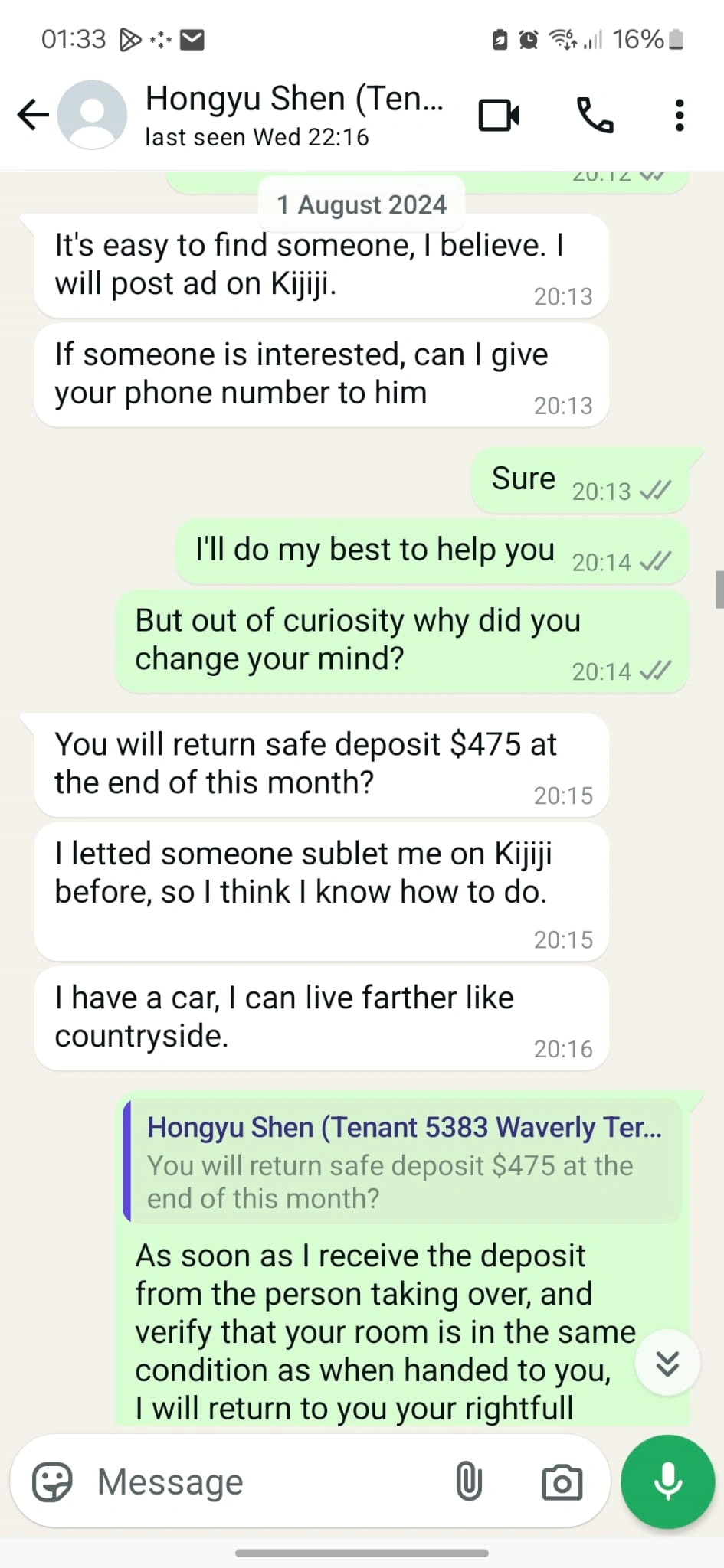
- Picture1:
- Shows me offering to help: “I’ll do my best to help you”
- Hongyu Shen says the reason for his decision to leave: “I have a car, I can live farther like countryside”
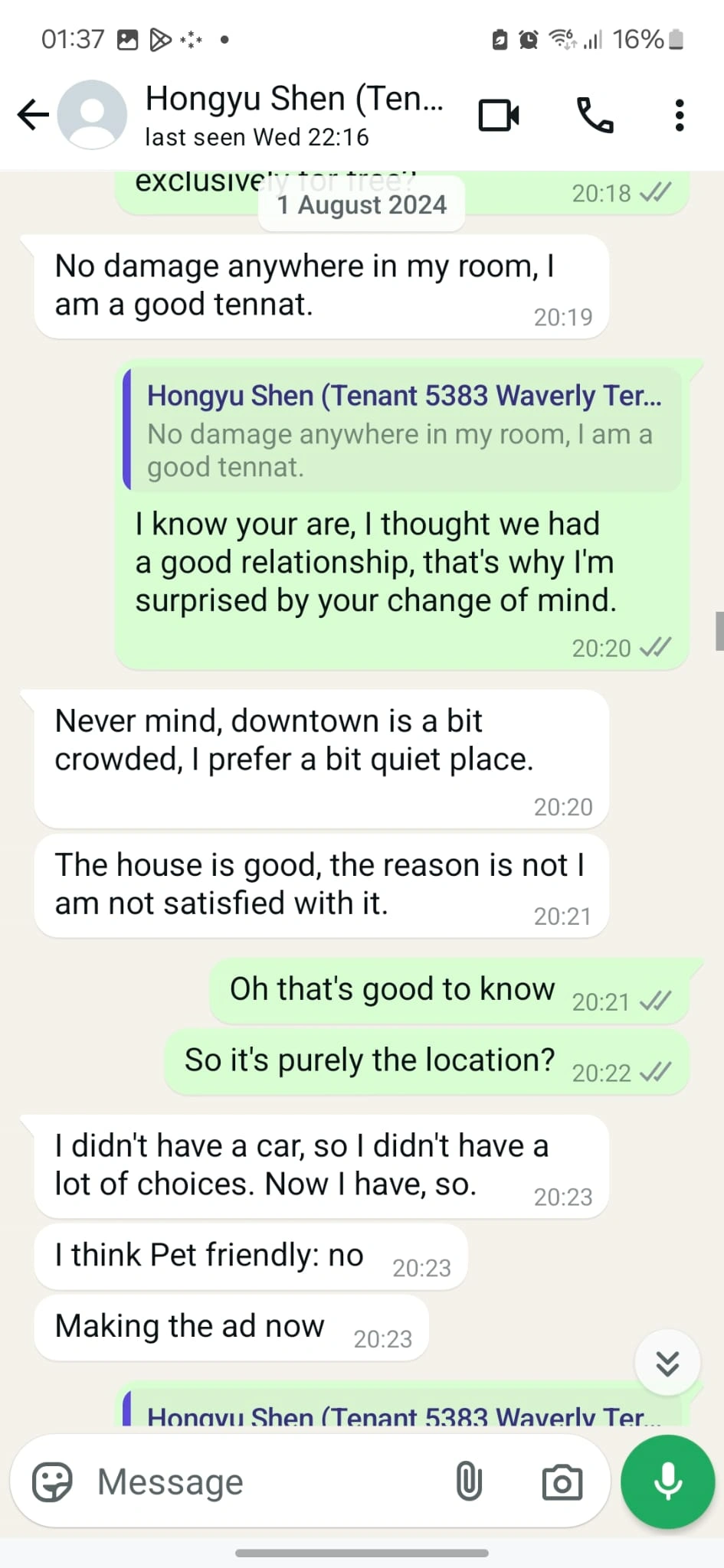
- Picture2:
- Hongyu Shen says the reason for his decision to leave: “downtown is a bit crowded, I prefer a bit quiet place.”, “The house is good, the reason is not I am not satisfied with it”
- I ask Hongyu Shen: “So it’s purely the location?”
- Hongyu Shen replies: “I didn’t have a car, so I didn’t have a lot of choice”
- Hongyu Shen only came up with complaints after he realized that he will be unable to find someone to take over his room.
On the 11th of august, Hongyu Shen first mentioned the issues relating to this hearing. His issues being Noise, Privacy, and Security. what is important to note is that he says that as general advice to improve the house not as complaints he wants to be addressed for himself, I know that because he outlined a suggested timeframe for adjustments and it is after he moves out. Hongyu Shen said that he brought these issues up because other people didn’t like his room.
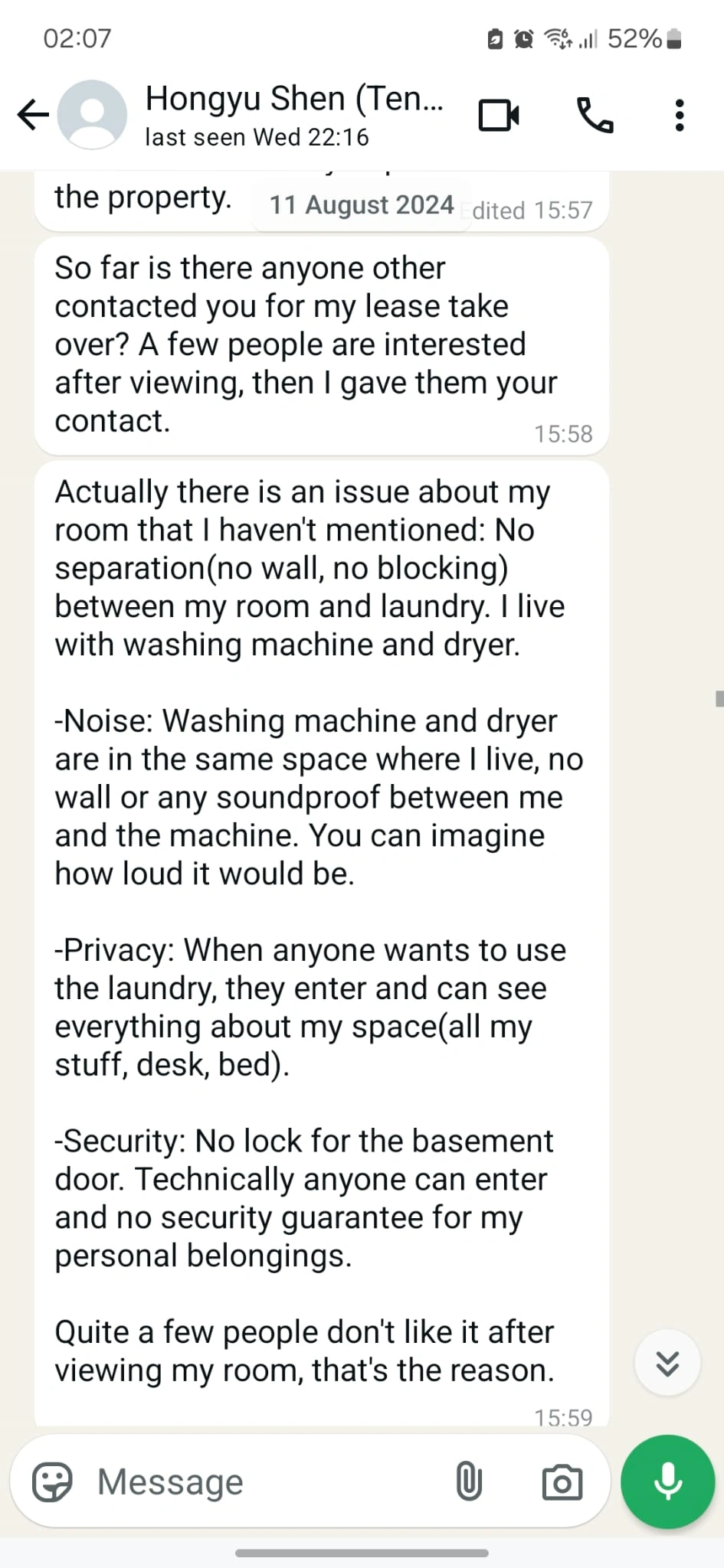
- Picture3:
- Hongyu Shen worries about finding a person to take over: “So far is there anyone other contacted you for my lease take over?”
- Hongyu Shen first time bringing up his issues: “Actually there is an issue about my room that I haven’t mentioned:…”, ”-Noise: Washing machine…”, ”-Privacy: When anyone…”, ”-Security: No lock…”
- Hongyu Shen explains why he brings up the issues: “Quite a few people don’t like it after viewing my room, that’s the reason.”
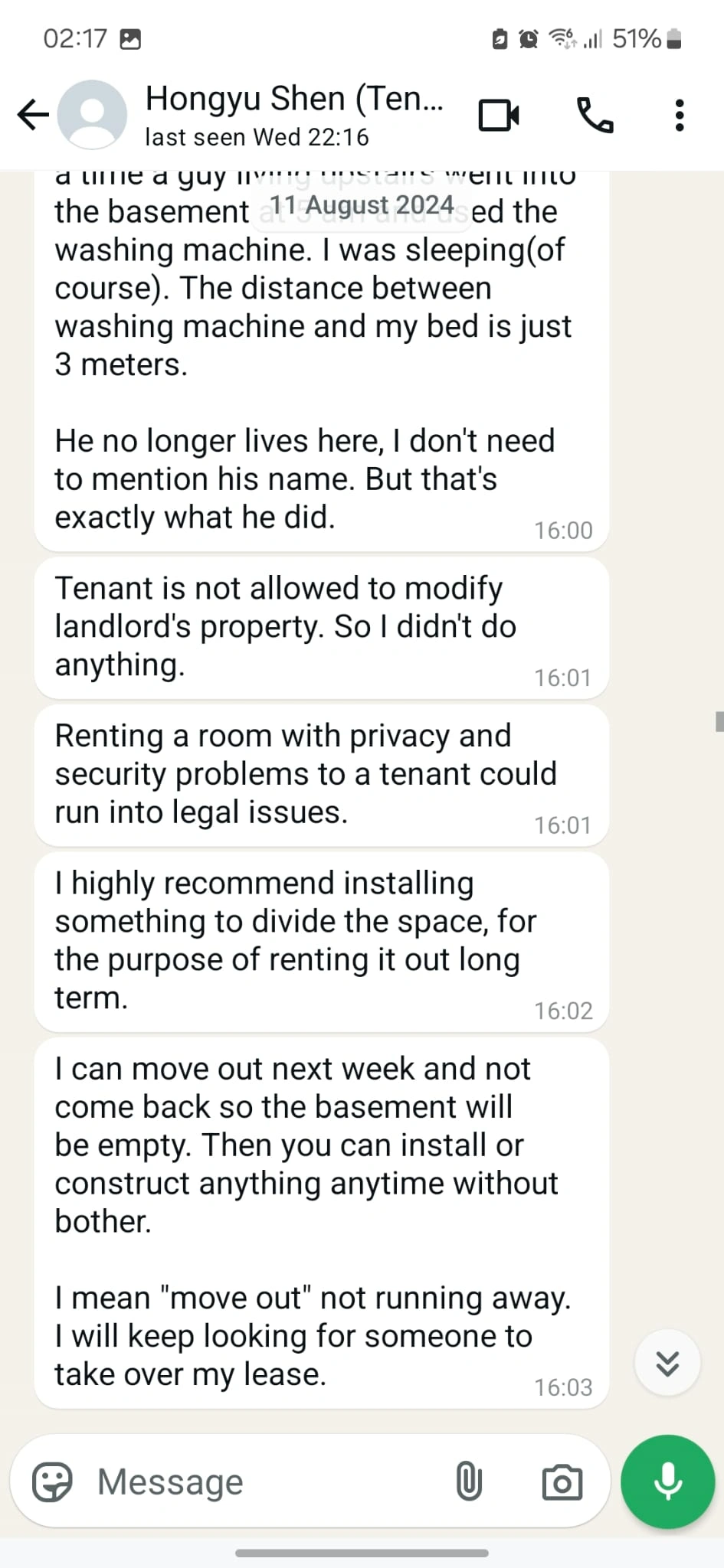
- Picture4:
- Hongyu Shen giving advice on how to improve the place: “I highly recommend installing something to divide the space, for the purpose of renting it out long term.”
- Hongyu Shen giving a suggested time frame for his suggestions: “I can move out next week and not come back so the basement will be empty. Then you can install or construct anything anytime without bother.”
On the 14th of august, Hongyu Shen told me that he doesn't think he will be able to find someone to sublet to. Hongyu Shen suggests that he can find someone to rent another room instead of his, since the other room is more desirable. I offer him to move to another room, so that he could continue the terms of the 2nd lease. Hongyu Shen refuses that offer, which confirms that his motivation to move out isn’t due to the room’s condition.
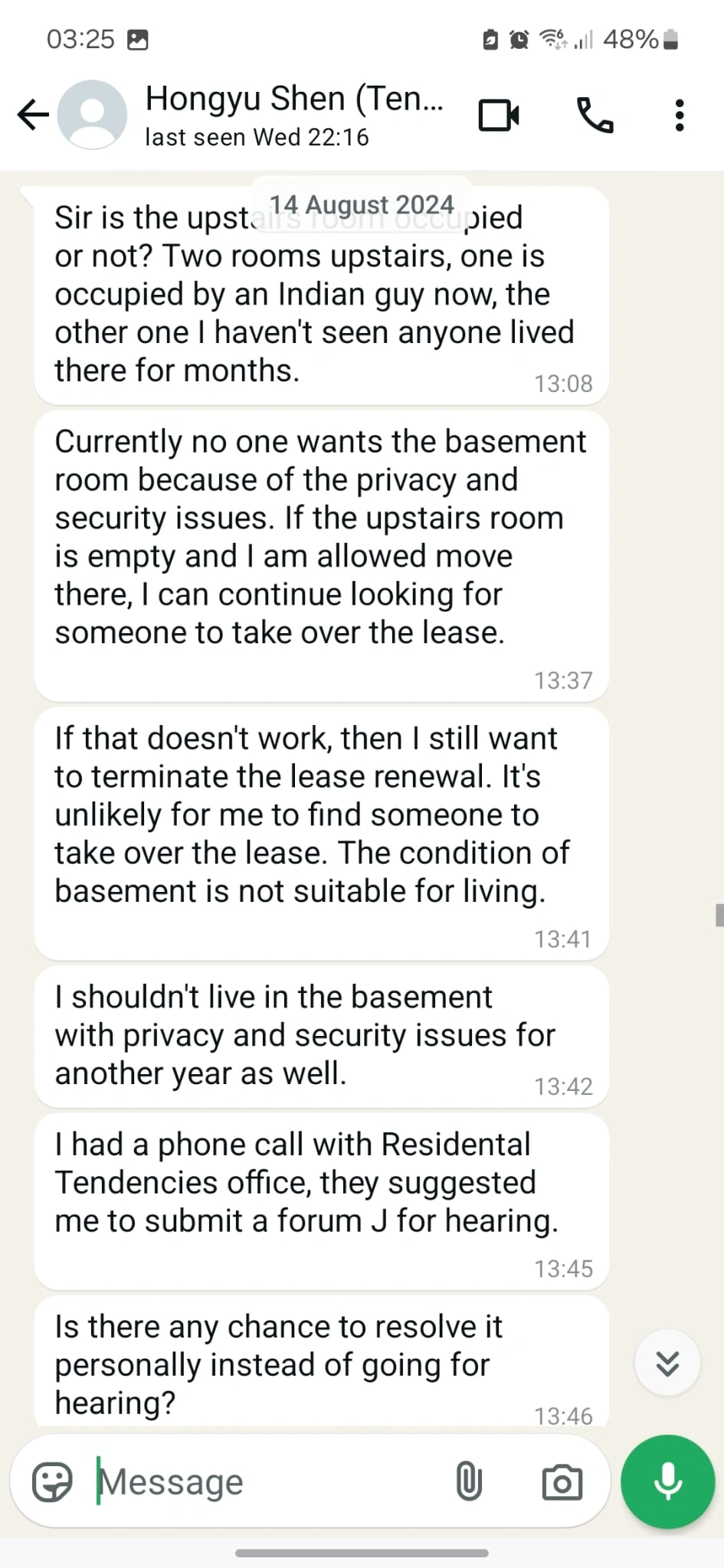
- Picture5:
- Hongyu Shen expresses that he is having difficulties finding someone to take over his lease: “Currently no one wants the basement room because of the privacy and security issues.”
- Hongyu Shen offers to find someone to take over for his next lease: “If the upstairs room is empty and I am allowed move there, I can continue looking for someone to take over the lease.”
- Hongyu Shen expresses doubt about being able to find a sublet: “It’s unlikely for me to find someone to take over the lease.”
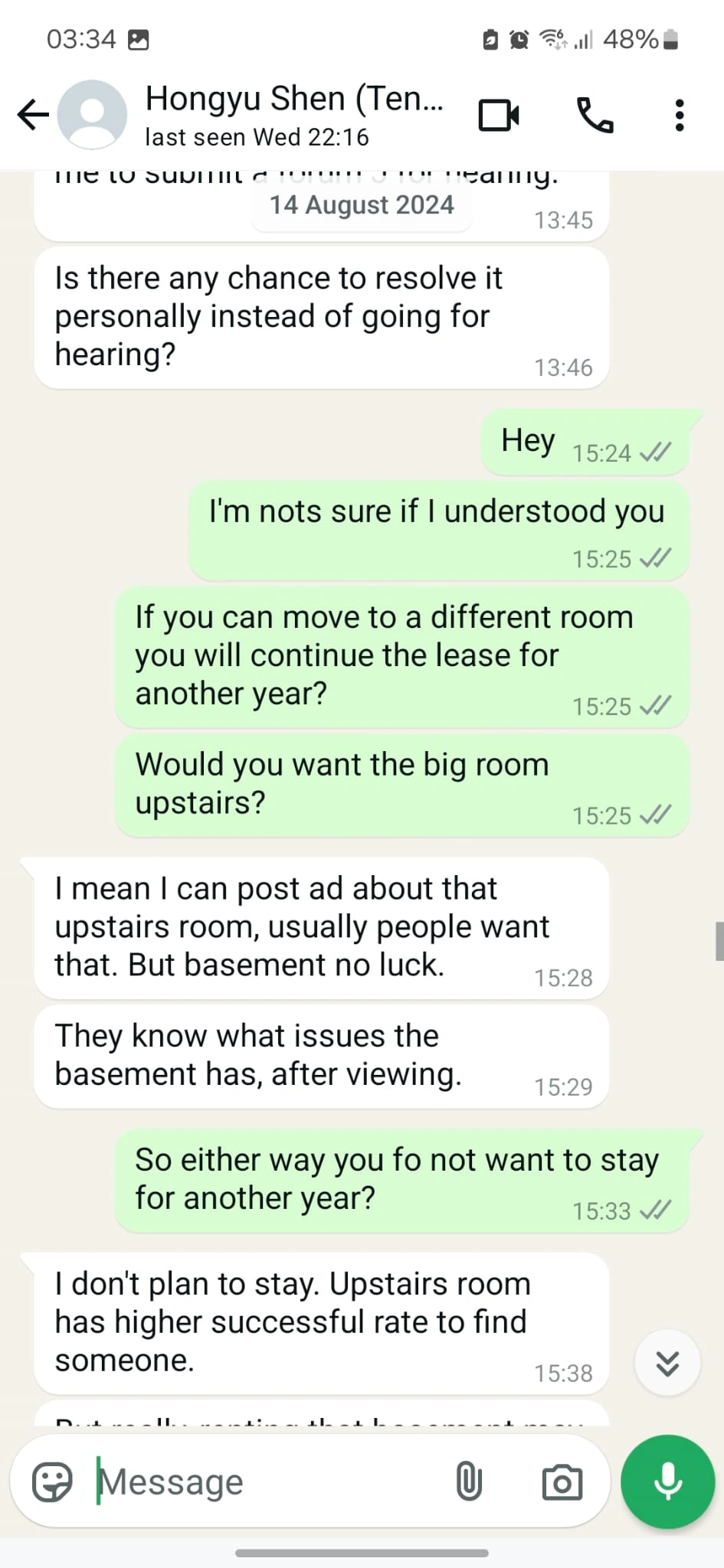
- Picture6:
- I asked for clarification: “I’m not sure if I understood you”, “If you can move to a different room you will continue the lease for another year?”
- I offered Hongyu Shen another room: “Would you want the big room upstairs?”
- Hongyu Shen clarifies: “I mean I can post ad about that upstairs room, usually people want that. But basement no luck.”, “I don’t plan to stay”
- Hongyu Shen and I already agreed to a settlement.
Hongyu Shen suggested to go to the tenancy board to legally break his lease on the ground that the room is “not suitable for living”. I suggested that doing so might backfire on him, if the board disagreed with him and he was forced to continue to pay rent to a place he wanted to move out from. At the end we settled all issues, where he would no longer be responsible for the room after August, in exchange for 1.5 times one month’s rent, which will allow me the opportunity to find a replacement. So after he moved out I paid him what is owed from his deposit, and that was what I thought was the end of our communications.
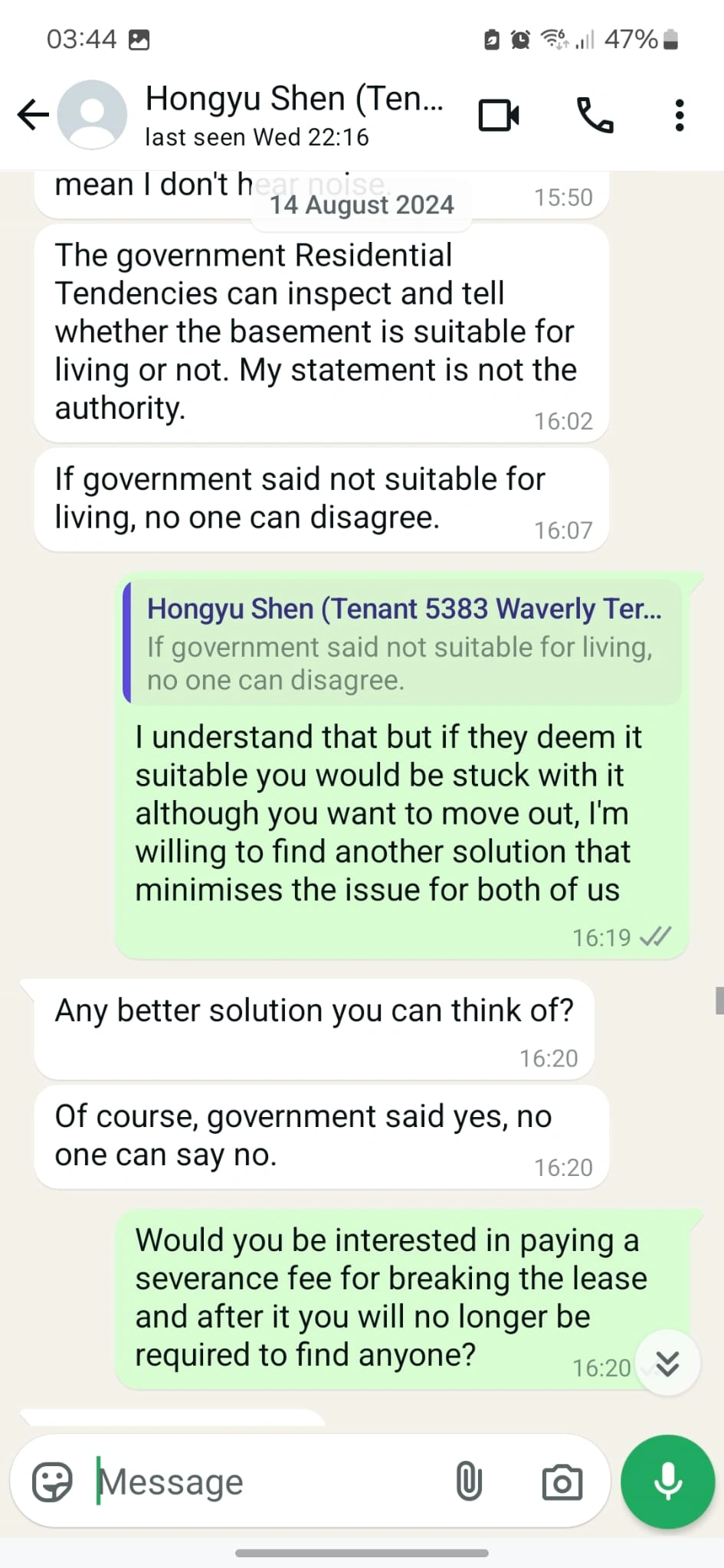
- Picture7:
- Suggests legal solutions: “The government Residential Tenancies can inspect and tell whether the basement is suitable for living or not”, “if the government said not suitable for living, no one can disagree.”
- I outline the outcome we are trying to avoid: “if they deem it suitable you would be stuck with it although you want to move out”
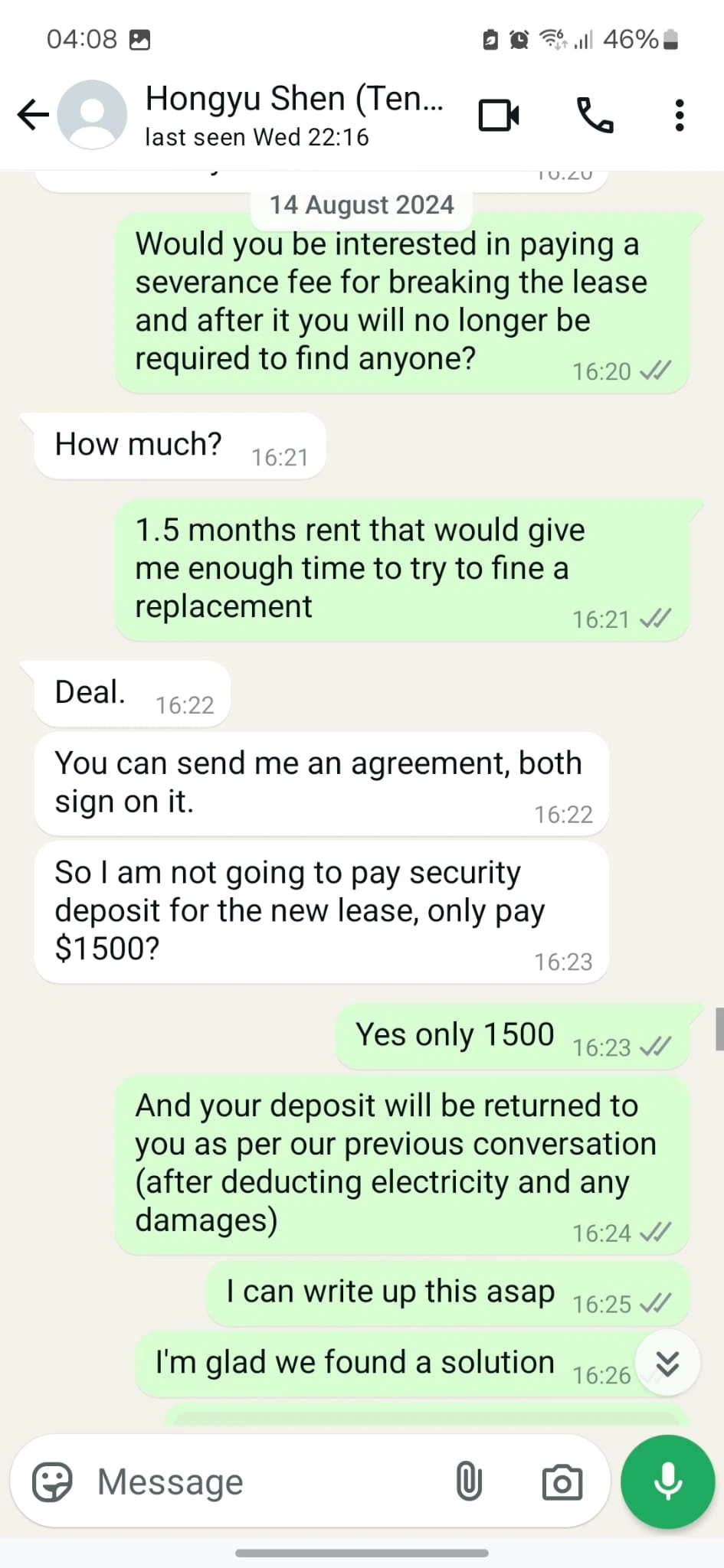
- Picture8:
- I suggest a settlement: “would you be interested in paying a severance fee…?”, “1.5 months rent…”, “Yes only 1500”.
- Hongyu Shen agrees to the terms: “Deal.”
- Hongyu Shen attempts to extort and libel me.
On October 20th, almost 2 months after Hongyu Shen moved out. Hongyu Shen sends me a libelous email, where he extorts me, for the same amount of money from our settlement, under the implicit threat of slander and libel through TV channels and other outlets.
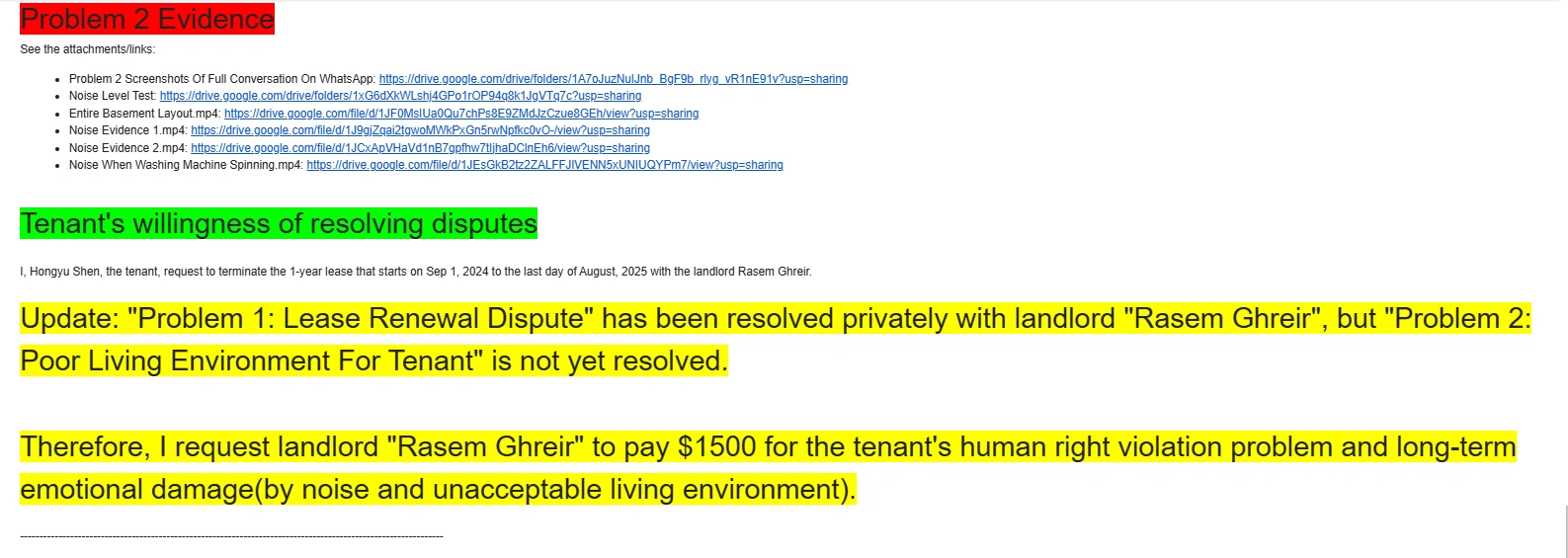
- Picture9: showing the extortionary demand by Hongyu Shen
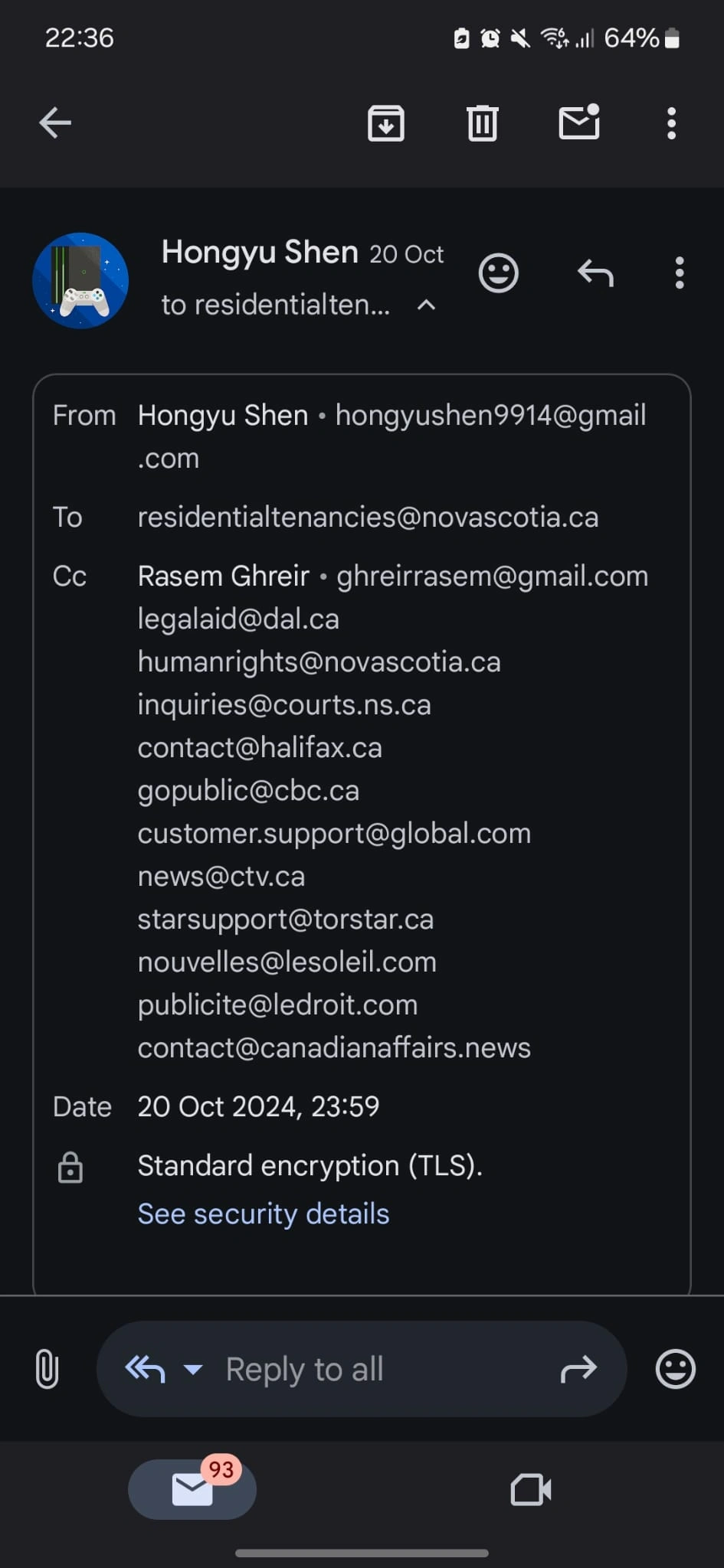
- Picture10: showing all the Emails CCed by Hongyu Shen, to threaten me, among them CBC, CTV, and Canada affairs news.
- Even for the sake of the argument we ignore Hongyu Shen's extortion/Blackmail, I think Hongyu Shen's complaints are erroneous, I will explain why each complaint is erroneous:
- Noise: The noise levels cited by Hongyu Shen (70–75 dB from the washer/dryer) are within normal ranges for household appliances and not sufficient to cause harm or violate rights.
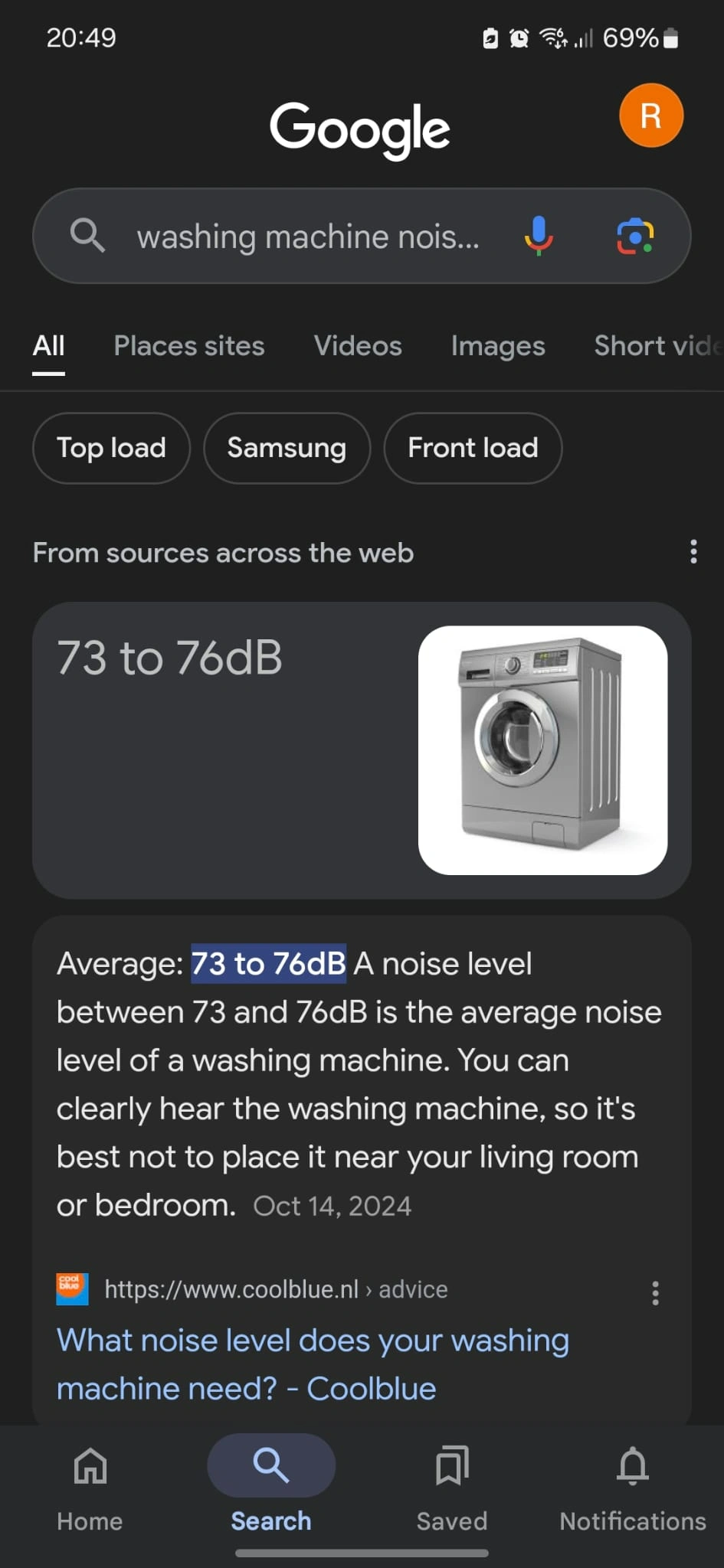
- Picture11: Shows the google results of washing machine noise level
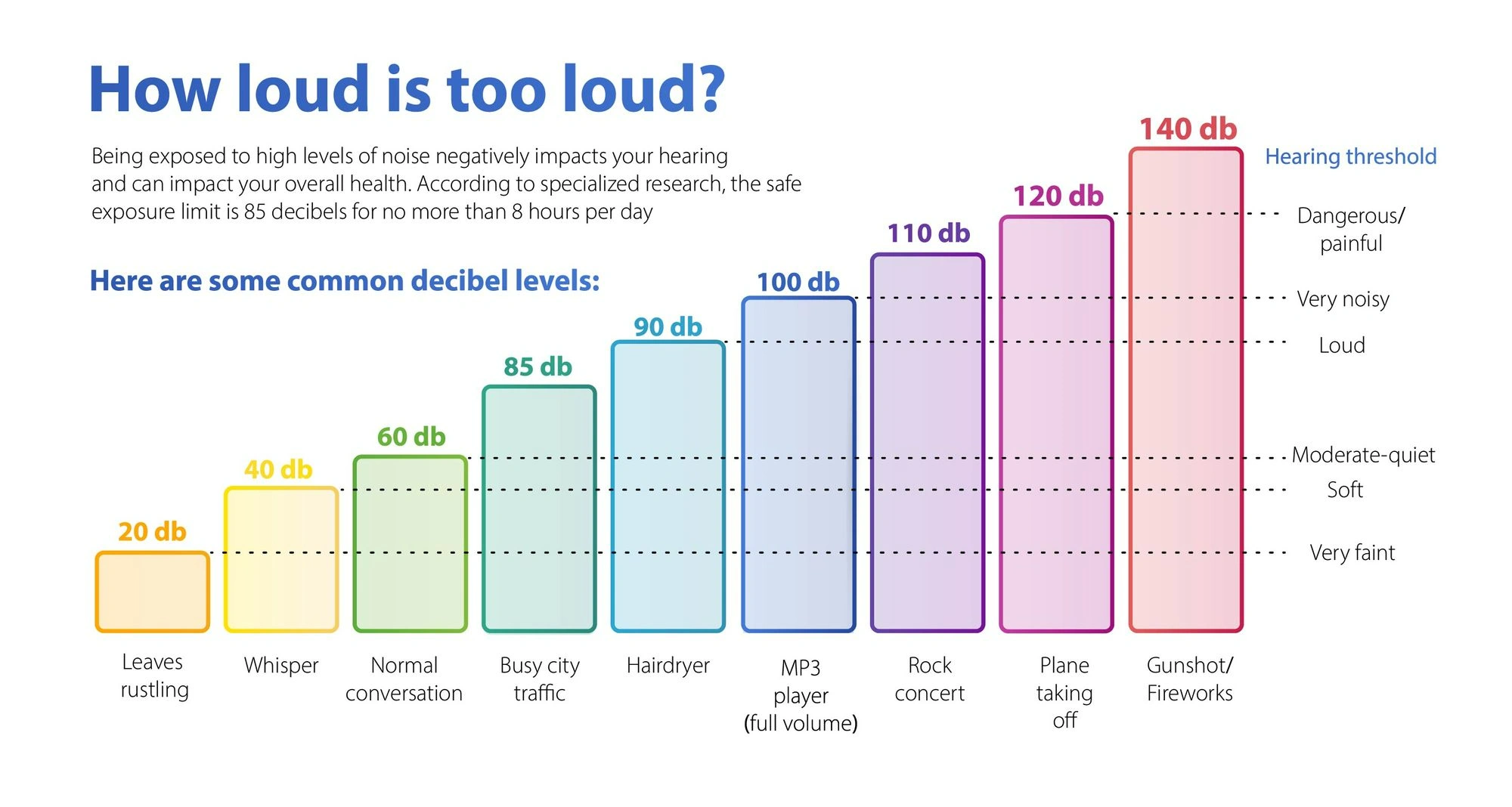
- Picture12: shows the sound level from different things: with the washer Hongyu Shen describes being slightly louder than a normal conversation, common objects/ events like hairdryer, MP3 player, and even city traffic.
- Privacy: Hongyu Shen’s room was entirely his own, with the understanding that other tenants might access the washer with his consent. No one is supposed to enter his room without his blessing. I never did anything that would violate Hongyu Shen's privacy.
- Security: During Hongyu Shen‘s suggested timeframe, I installed a lock after being informed of the issue, addressing any concerns about security.
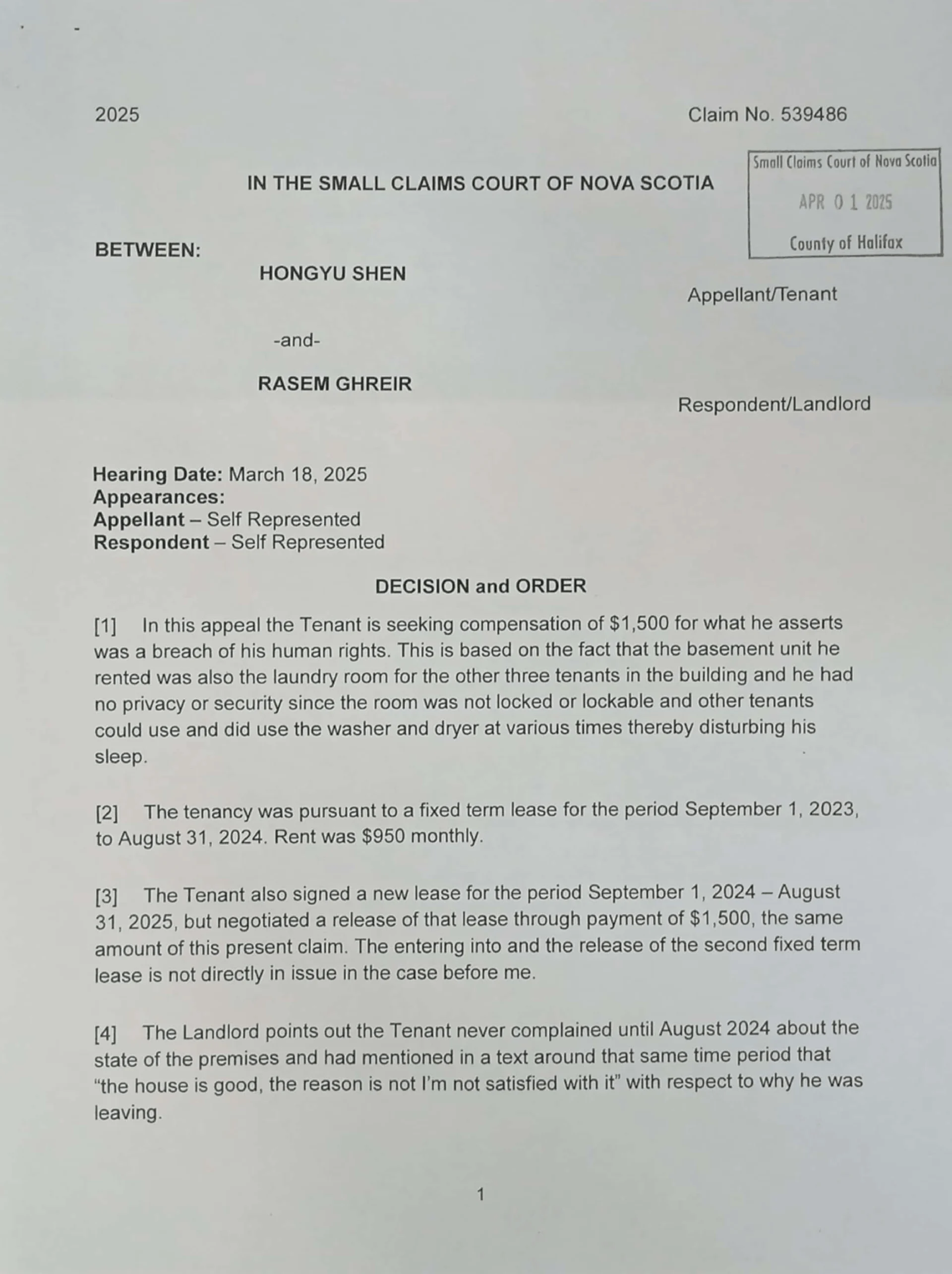
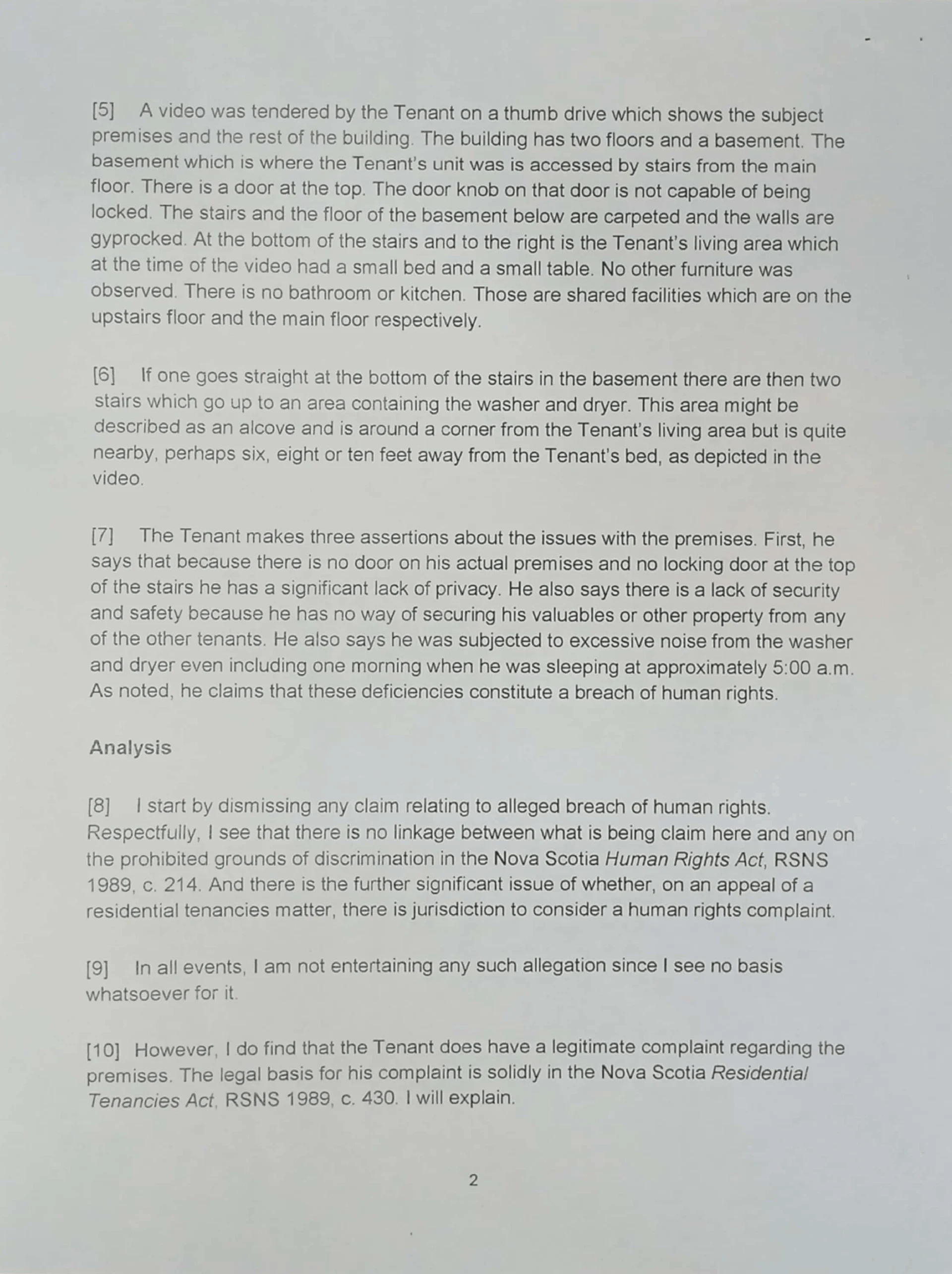
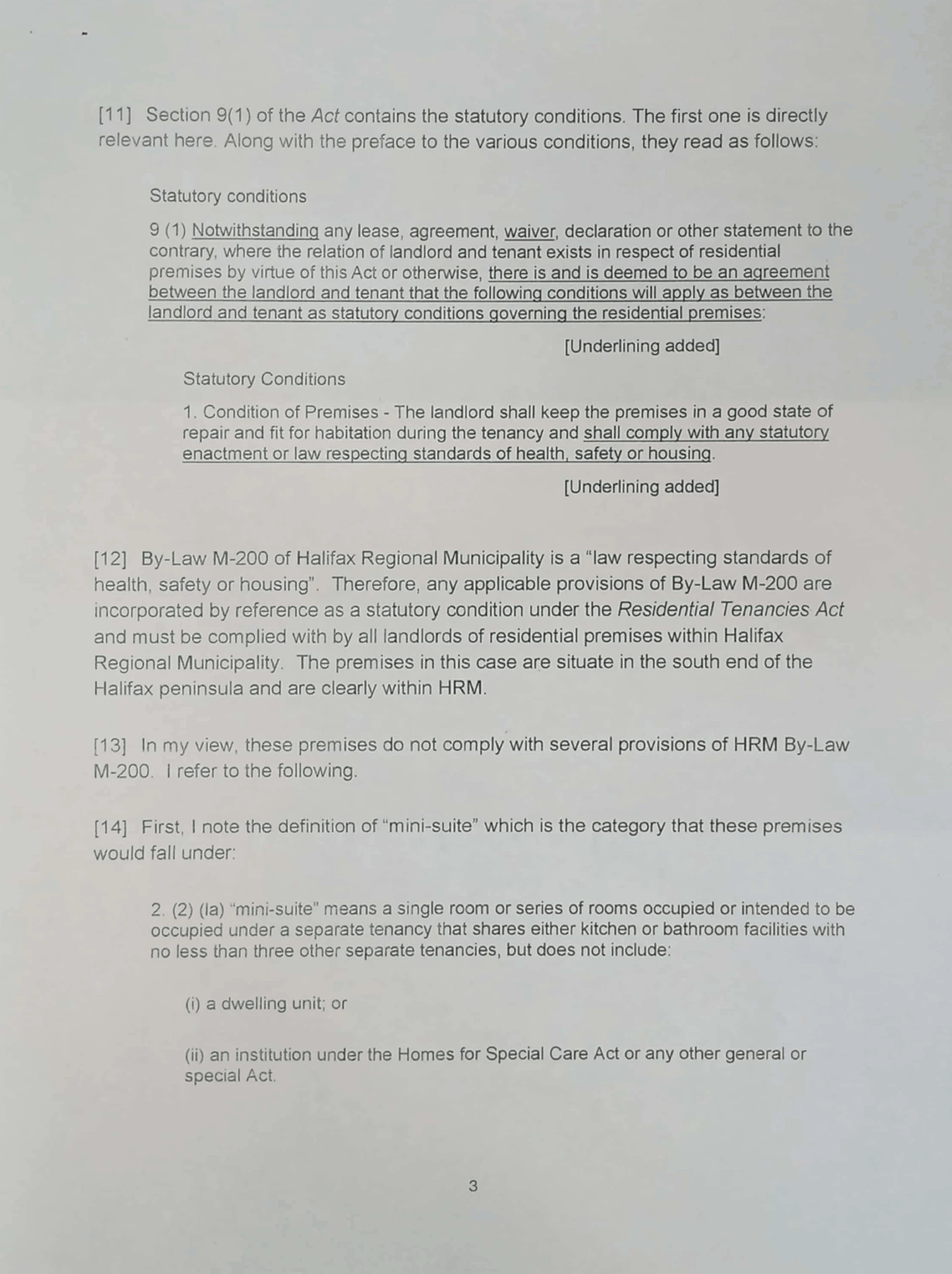
DECISION and ORDER
[1] In this appeal the Tenant is seeking compensation of $1,500 for what he asserts was a breach of his human rights. This is based on the fact that the basement unit he rented was also the laundry room for the other three tenants in the building and he had no privacy or security since the room was not locked or lockable and other tenants could use and did use the washer and dryer at various times thereby disturbing his sleep.
[2] The tenancy was pursuant to a fixed term lease for the period September 1, 2023, to August 31, 2024. Rent was $950 monthly.
[3] The Tenant also signed a new lease for the period September 1, 2024 - August 31, 2025, but negotiated a release of that lease through payment of $1,500, the same amount of this present claim. The entering into and the release of the second fixed term lease is not directly in issue in the case before me.
[4] The Landlord points out the Tenant never complained until August 2024 about the state of the premises and had mentioned in a text around that same time period that "the house is good, the reason is not I'm not satisfied with it" with respect to why he was leaving.
[5] A video was tendered by the Tenant on a thumb drive which shows the subject premises and the rest of the building. The building has two floors and a basement. The basement which is where the Tenant's unit was is accessed by stairs from the main floor. There is a door at the top. The door knob on that door is not capable of being locked. The stairs and the floor of the basement below are carpeted and the walls are gyprocked. At the bottom of the stairs and to the right is the Tenant's living area which at the time of the video had a small bed and a small table. No other furniture was observed. There is no bathroom or kitchen. Those are shared facilities which are on the upstairs floor and the main floor respectively.
[6] If one goes straight at the bottom of the stairs in the basement there are then two stairs which go up to an area containing the washer and dryer. This area might be described as an alcove and is around a corner from the Tenant's living area but is quite nearby, perhaps six, eight or ten feet away from the Tenant's bed, as depicted in the video.
[7] The Tenant makes three assertions about the issues with the premises. First, he says that because there is no door on his actual premises and no locking door at the top of the stairs he has a significant lack of privacy. He also says there is a lack of security and safety because he has no way of securing his valuables or other property from any of the other tenants. He also says he was subjected to excessive noise from the washer and dryer even including one morning when he was sleeping at approximately 5:00 a.m. As noted, he claims that these deficiencies constitute a breach of human rights.
Analysis
[8] I start by dismissing any claim relating to alleged breach of human rights. Respectfully, I see that there is no linkage between what is being claim here and any on the prohibited grounds of discrimination in the Nova Scotia Human Rights Act, RSNS 1989, c. 214. And there is the further significant issue of whether, on an appeal of a residential tenancies matter, there is jurisdiction to consider a human rights complaint.
[9] In all events, I am not entertaining any such allegation since I see no basis whatsoever for it.
[10] However, I do find that the Tenant does have a legitimate complaint regarding the premises. The legal basis for his complaint is solidly in the Nova Scotia Residential Tenancies Act, RSNS 1989, c. 430. I will explain.
[11] Section 9(1) of the Act contains the statutory conditions. The first one is directly relevant here. Along with the preface to the various conditions, they read as follows:
Statutory conditions
9 (1)Notwithstanding any lease, agreement,waiver , declaration or other statement to the contrary, where the relation of landlord and tenant exists in respect of residential premises by virtue of this Act or otherwise,there is and is deemed to be an agreement between the landlord and tenant that the following conditions will apply as between the landlord and tenant as statutory conditions governing the residential premises :
Statutory Conditions
1. Condition of Premises - The landlord shall keep the premises in a good state of repair and fit for habitation during the tenancy andshall comply with any statutory enactment or law respecting standards of health, safety or housing .
[12] By-Law M-200 of Halifax Regional Municipality is a "law respecting standards of health, safety or housing". Therefore, any applicable provisions of By-Law M-200 are incorporated by reference as a statutory condition under the Residential Tenancies Act and must be complied with by all landlords of residential premises within Halifax Regional Municipality. The premises in this case are situate in the south end of the Halifax peninsula and are clearly within HRM.
[13] In my view, these premises do not comply with several provisions of HRM By-Law M-200. I refer to the following.
[14] First, I note the definition of "mini-suite" which is the category that these premises would fall under:
2. (2) (la) "mini-suite" means a single room or series of rooms occupied or intended to be occupied under a separate tenancy that shares either kitchen or bathroom facilities with no less than three other separate tenancies, but does not include:
(i) a dwelling unit; or
(ii) an institution under the Homes for Special Care Act or any other general or special Act.
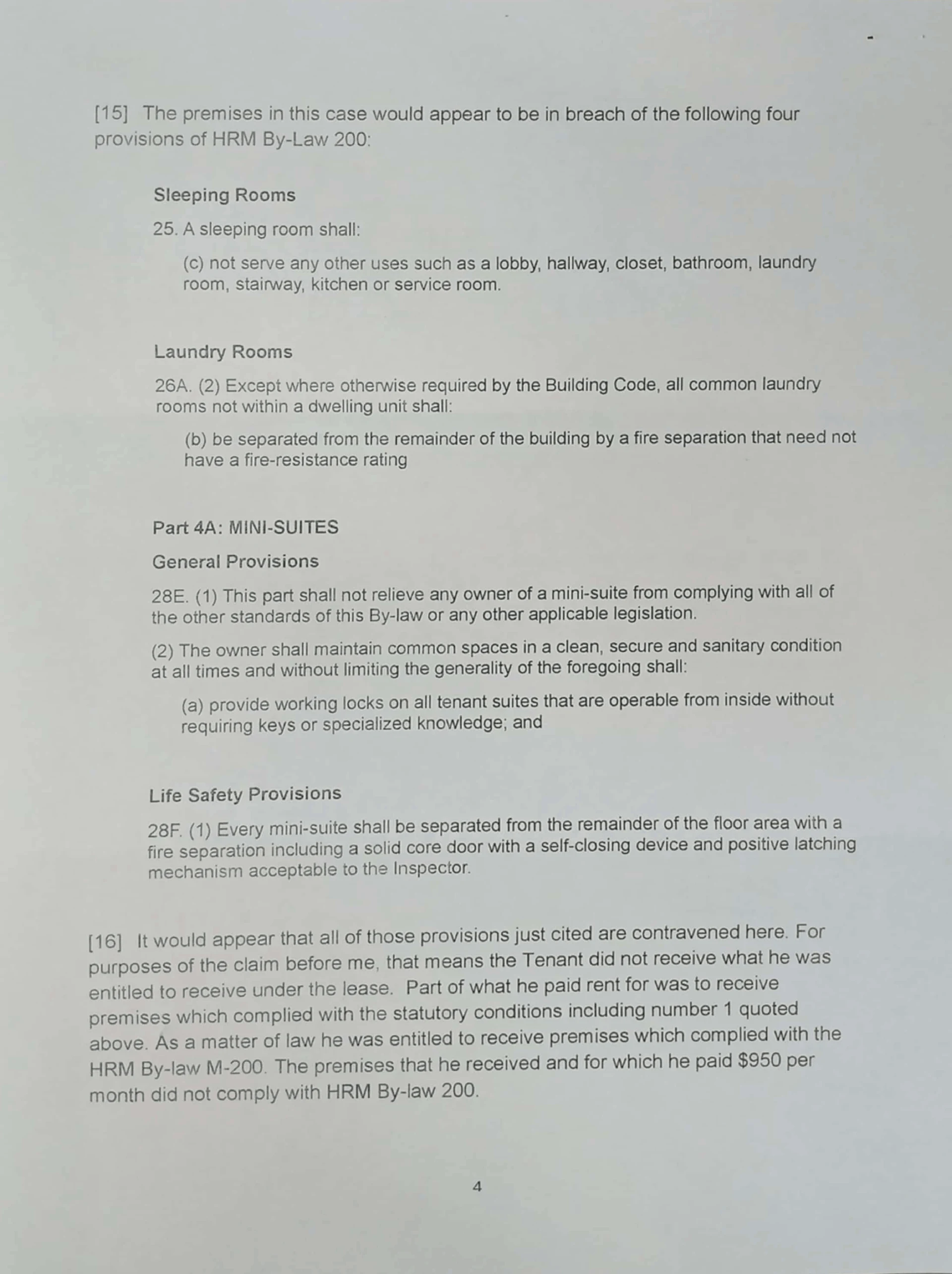
[15] The premises in this case would appear to be in breach of the following four provisions of HRM By-Law 200:
Sleeping Rooms
25. A sleeping room shall:
(c) not serve any other uses such as a lobby, hallway, closet, bathroom, laundry room, stairway, kitchen or service room.
Laundry Rooms
26A. (2) Except where otherwise required by the Building Code, all common laundry rooms not within a dwelling unit shall:
(b) be separated from the remainder of the building by a fire separation that need not have a fire-resistance rating
Part 4A: MINI-SUITES
General Provisions
28E. (1) This part shall not relieve any owner of a mini-suite from complying with all of the other standards of this By-law or any other applicable legislation.
(2) The owner shall maintain common spaces in a clean, secure and sanitary condition at all times and without limiting the generality of the foregoing shall:(a) provide working locks on all tenant suites that are operable from inside without requiring keys or specialized knowledge; and
Life Safety Provisions
28F. (1) Every mini-suite shall be separated from the remainder of the floor area with a fire separation including a solid core door with a self-closing device and positive latching mechanism acceptable to the Inspector.
[16] It would appear that all of those provisions just cited are contravened here. For purposes of the claim before me, that means the Tenant did not receive what he was entitled to receive under the lease. Part of what he paid rent for was to receive premises which complied with the statutory conditions including number 1 quoted above. As a matter of law he was entitled to receive premises which complied with the HRM By-law M-200. The premises that he received and for which he paid $950 per month did not comply with HRM By-law 200.
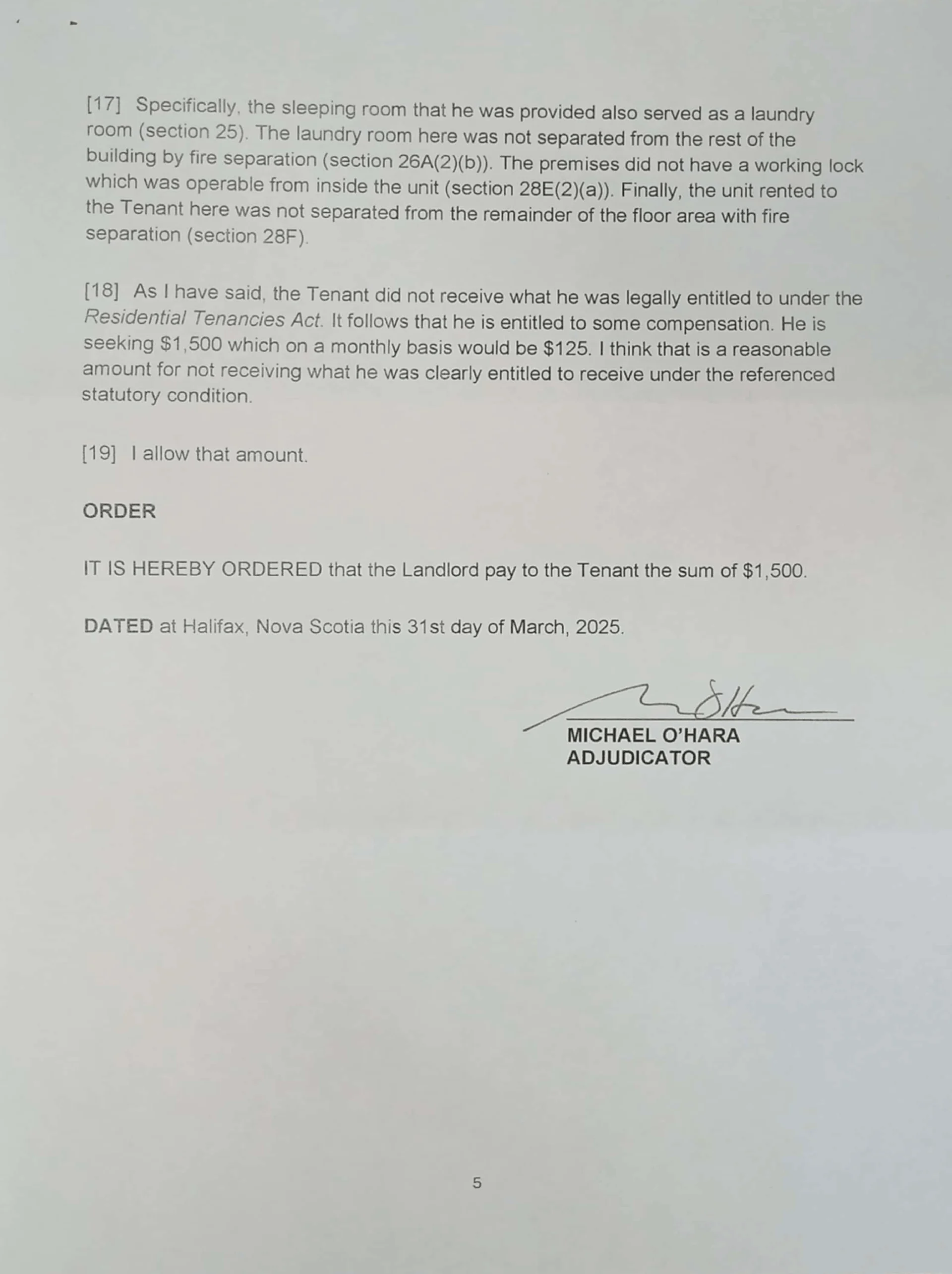
[17] Specifically, the sleeping room that he was provided also served as a laundry room (section 25). The laundry room here was not separated from the rest of the building by fire separation (section 26A(2)(b)). The premises did not have a working lock which was operable from inside the unit (section 28E(2)(a)). Finally, the unit rented to the Tenant here was not separated from the remainder of the floor area with fire separation (section 28F).
[18] As I have said, the Tenant did not receive what he was legally entitled to under the Residential Tenancies Act. It follows that he is entitled to some compensation. He is seeking $1,500 which on a monthly basis would be $125. I think that is a reasonable amount for not receiving what he was clearly entitled to receive under the referenced statutory condition.
[19] I allow that amount.
ORDER
IT IS HEREBY ORDERED that the Landlord pay to the Tenant the sum of $1,500.
DATED at Halifax, Nova Scotia this 31st day of March, 2025.
MICHAEL O'HARA
ADJUDICATOR
Rasem Ghreir
Compensation
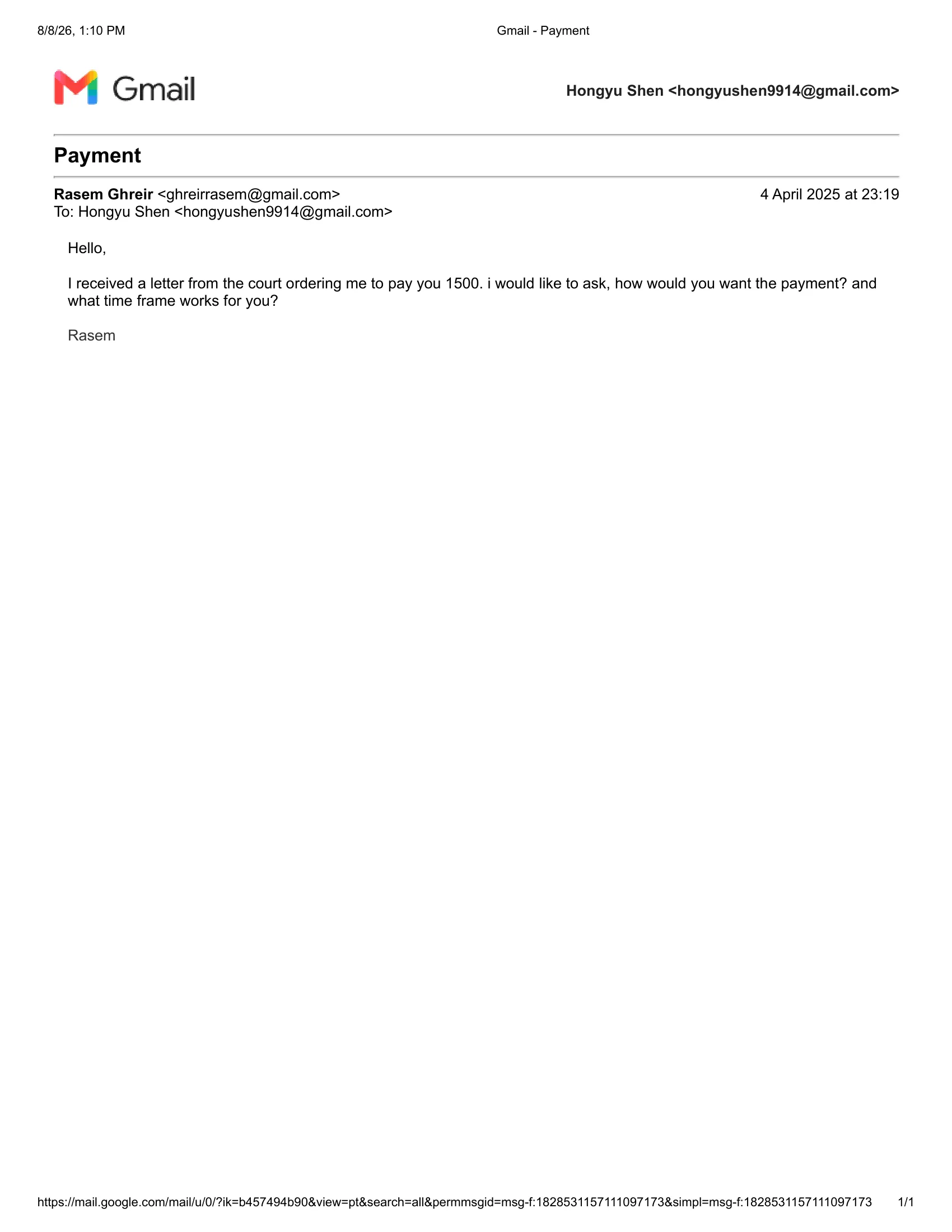

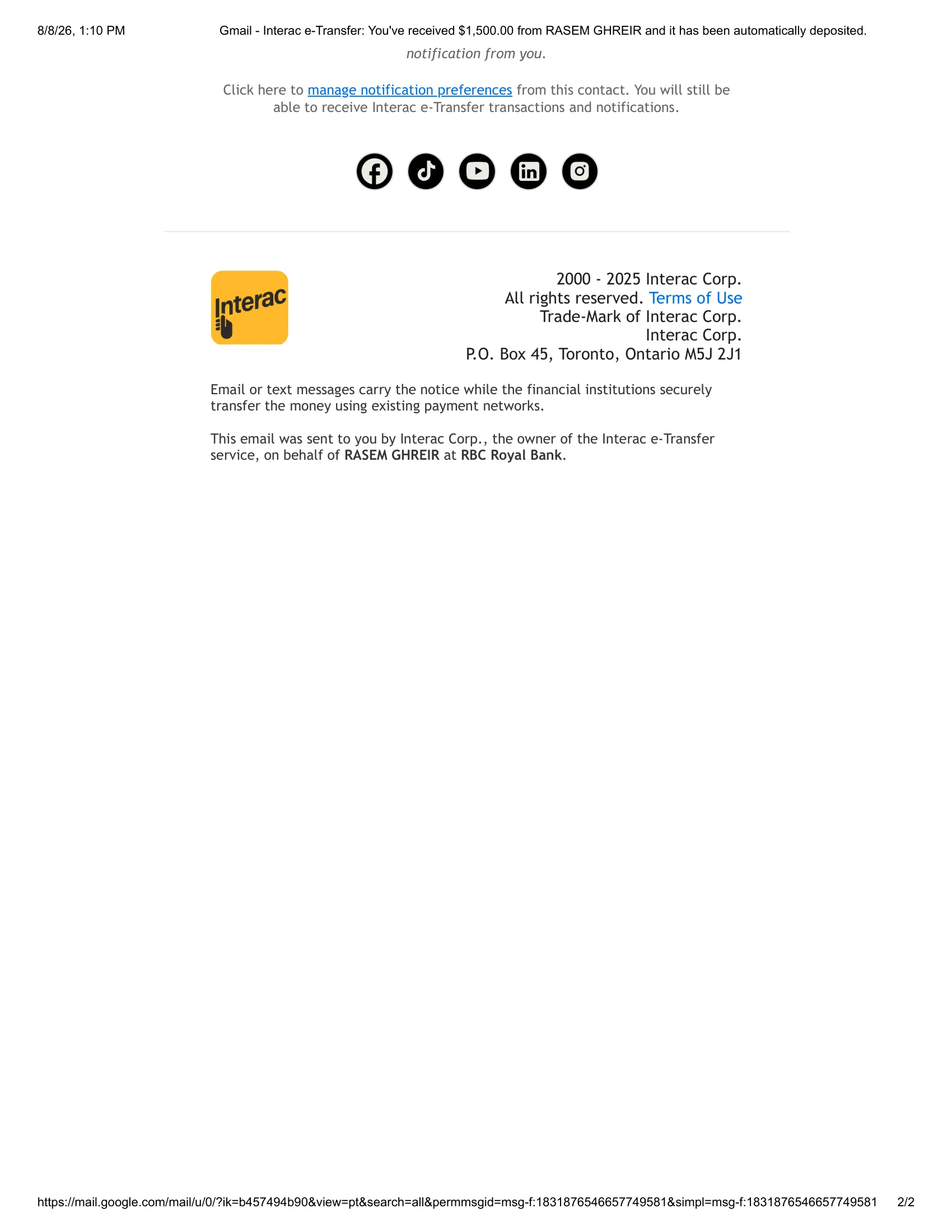 Landlord Rasem Ghreir lost the Small Claims Court case, was found to have violated multiple housing and safety
requirements, and was ordered to pay the tenant CA$1,500.
Landlord Rasem Ghreir lost the Small Claims Court case, was found to have violated multiple housing and safety
requirements, and was ordered to pay the tenant CA$1,500.